An event horizon is a causal boundary: signals from its interior cannot reach a specified distant future observer. In quantum field theory on a collapsing classical geometry, outgoing radiation is correlated with degrees of freedom inaccessible behind that boundary. Discarding the inaccessible degrees of freedom gives an approximately thermal outside state.
This alone is ordinary quantum mechanics: half of an entangled pair is mixed. The difficulty becomes sharp if a black hole formed from a pure state evaporates completely and the entire final radiation remains mixed. Unitary evolution, which preserves inner products and information in the complete quantum state, preserves purity. A pure-to-mixed final map would require an additional physical account.
The question is not whether radiation looks thermal to a simple detector. A globally pure state can make every small part look nearly thermal. The question concerns the correlations among all the emitted parts.
What is known, and what is open
Semiclassical Hawking radiation is a controlled leading description when the background curvature is small and quantum backreaction is treated appropriately. Direct observation of Hawking radiation from an astrophysical black hole has not established its full quantum state. Holographic calculations and the island prescription reproduce entropy behavior compatible with unitary evaporation in specified gravitational models. [5][6]
An island is a bulk region that must be included with the radiation when evaluating an appropriate generalized entropy. It is not matter physically jumping through the horizon. It changes which bulk degrees of freedom are encoded in a chosen radiation subsystem. The calculations provide substantial progress on the entropy question. They do not by themselves provide a practical decoder for an arbitrary evaporating four-dimensional black hole or a universally accepted microscopic account of every interior observation.
Build the minimum theory
For a density operator $\rho_R$ describing radiation $R$, define the dimensionless von Neumann entropy
$$S(R)=-\operatorname{Tr}(\rho_R\ln\rho_R).$$
It vanishes for a pure state and measures mixedness, not directly what a computationally limited observer can recover. Physical entropy is $k_B S$, with $k_B$ Boltzmann's constant. A pure total state on radiation $R$ and remaining black hole $B$ obeys $S(R)=S(B)$ because both reduced states have the same nonzero eigenvalues.
Here $I$ is a candidate island, $\partial I$ its boundary, and $A$ the boundary area. “Extremize” means vary the boundary to find a stationary generalized entropy; “minimize” means choose the relevant smallest saddle among candidates, including no island. The matter entropy and gravitational terms must be renormalized consistently. The formula has assumptions about the semiclassical expansion and which saddle contributions are admitted. [6]
Worked example: the Page shape without gravity
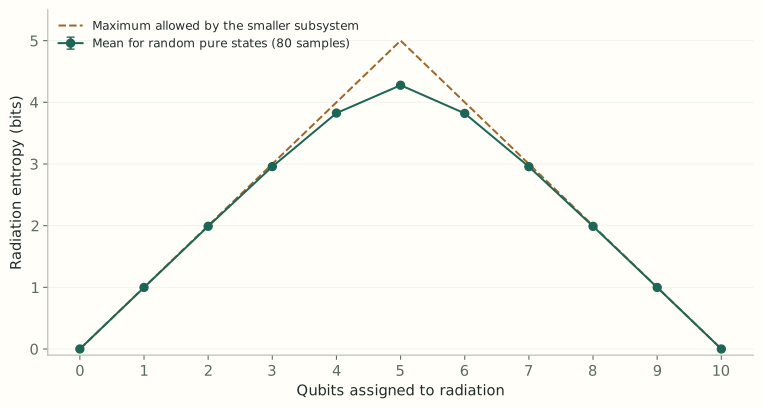
Take a pure state of $N$ qubits, with no conserved quantities imposed, sampled uniformly from the unit sphere. After assigning $n$ qubits to radiation, subsystem dimensions are $d_R=2^n$ and $d_B=2^{N-n}$. Entropy cannot exceed the logarithm of the smaller dimension:
$$S(R)\leq \min(n,N-n)\ln2.$$
Typical highly entangled pure states lie close to this bound away from the central crossover. Early radiation entropy grows because the smaller radiation subsystem becomes entangled with the larger remainder. Late radiation entropy decreases because the shrinking remainder cannot purify arbitrarily many independent radiation degrees of freedom. This motivates the Page curve, named after the random-state analysis. [4]
Uniform random pure states of 10 qubits, averaged over 80 samples at each division. The upper dashed envelope is the smaller subsystem's maximum entropy. This is a reproducible kinematic example, not a numerical simulation of black-hole evaporation.
Now compare $n$ independent Bell pairs, each with one emitted qubit and one permanently hidden partner. Tracing all hidden partners yields $S(R)=n\ln2$. This construction cannot describe complete unitary evaporation while retaining all its assumptions. One must explain what changes: independence, subsystem identification, near-horizon state, or the proposed final degrees of freedom.
Insight. Drawing a decreasing entropy curve is easy once global purity and a shrinking complement are assumed. Explaining why gravitational dynamics realizes the required correlations is the physical task. Entropy alone also leaves many possible states indistinguishable.
Questions to investigate
Calibration questions have established answers. Diagnostics ask what follows inside a specified model or comparison. Extensions are bounded proposals whose novelty and feasibility need a focused literature check. Each answer should record its assumptions and limits.
BH-1 · Black holes and informationCalibration
Why do independent Hawking-like pairs fail to purify radiation?
Do: Construct one, two, and three Bell pairs. Trace their partners and compute radiation entropy. Compare with arbitrary pure states on the same total qubits.
Check: Entropy is additive for independent pairs; a pure total state has equal entropies on complementary factors.
Meaning: Isolates the offending independence assumption in a solvable model. The Bell-pair construction approximates only part of the Hawking argument.
Does the entropy curve identify the radiation state?
Do: Construct different pure states with identical bipartite Schmidt coefficients, the nonnegative weights in a paired basis decomposition. Compare their local correlation functions.
Check: Entropies agree while a chosen observable differs. Report that observable and the measurement basis.
Meaning: Produces an explicit limit on what an island entropy calculation alone establishes about decoding or local measurements.
Do: Choose one two-dimensional evaporating model from the island review. Reproduce its no-island and island generalized entropies, including its matter state and regulator prescription.
Check: Verify the extremization before taking the minimum; track the domain of the semiclassical approximation.
Meaning: A successful output is a model-specific transition with assumptions, not an unqualified solution for every black hole.
How robust is the entropy transition to an imperfect radiation collector?
Do: In that same model, first replace complete collection by a specified erasure channel in a finite-dimensional analogue. Vary collection efficiency and compute entropy and recoverable correlations separately.
Check: Recover full collection and total loss limits. Do not transplant the qubit channel into a gravitational bath without deriving the correspondence.
Meaning: Identifies an operationally precise modification worth comparing with existing partial-bath calculations; novelty remains to be checked.
BH-1 through BH-3 form a compact conceptual project: distinguish pair production, global purity, entropy, and accessible correlations. Proceed to BH-4 only after those distinctions survive explicit matrices. This makes the gravitational calculation answer a question we already understand.