SC · Collective physics · Five questions to investigate
Unconventional superconductivity
What binds pairs, and what lets their phases act together?
For a physicist entering another fieldSources checked 12 September 2026Editable working edition
The guiding question
Which ingredients produce a robust superconducting state in a controlled model, and which evidence is needed to transfer that mechanism to a particular material?
Starting knowledge: Fermions, hopping, local interactions, and the distinction between a state and a thermodynamic phase.
The original cuprate document is preserved as a separate reference copy. It supplied the structural model for this collection: facts, reductions to Hamiltonians, competing mechanisms, and questions that guide the next calculation. Its detailed claims and proposed numerical projects remain research inputs requiring their own checks. This companion gives a shorter entry and makes explicit which conclusions a small model can support.
The physical question
A superconductor supports a collective coherent charged state, with characteristic electromagnetic responses such as magnetic-flux expulsion. A finite sample can have low resistance for several reasons; a convincing identification uses complementary probes. The microscopic question is how an electronic system becomes unstable toward a paired state, which pairing pattern it selects, and what sets the temperature at which coherent response is sustained.
Pair amplitude describes how strongly the system favors paired electronic correlations. Phase stiffness measures the energy cost of twisting the phase of the collective order across space. Strong pairing need not imply large stiffness. A system can form tightly bound pairs that move so poorly that global coherence occurs only at low temperature.
What is known, and what is open
Cuprates are layered materials descended from strongly correlated insulating parent compounds. Their phenomenology motivates repulsive-interaction models, sign-changing pairing, and competing charge or spin order. But establishing a useful electronic mechanism within a Hamiltonian differs from showing that this Hamiltonian, with material-derived parameters, explains all relevant observables.
Numerical work on the square-lattice Hubbard model with next-neighbor hopping finds regimes with superconducting and stripe correlations, using complementary methods and substantial extrapolation. A stripe is a spatial modulation of charge and often spin correlations. The result is an important model benchmark; geometry, coupling, doping, and extrapolation remain part of its scope. [37]
Rigorous stiffness and transition-temperature bounds exist for stated Hamiltonian classes, including useful two-dimensional results. An upper bound tells us what cannot be exceeded; it does not show that a material reaches the bound or identify its actual bottleneck. [38]
$c^\dagger_{i\sigma}$ creates an electron on site $i$ with spin $\sigma$; $n=c^\dagger c$ counts occupation. The first sum includes each chosen bond once, and “h.c.” adds the Hermitian conjugate hopping. $t_{ij}$ is a hopping energy, while $U>0$ penalizes two opposite-spin electrons on the same site. One band is already a physical reduction: real copper–oxygen materials have several orbital and charge-transfer scales.
A Mott insulator is insulating because interactions obstruct charge motion even where a simple partly filled noninteracting band would conduct. At one electron per site and large $U/t$, virtual hopping can still exchange neighboring spins. The low-energy interaction favors certain spin arrangements without requiring free charge motion.
Worked example: repulsion generates an antiferromagnetic exchange scale
Take two sites, two electrons, and real hopping $t>0$. In the singlet sector, the separated singlet couples to a symmetric doubly occupied configuration. The relevant matrix is
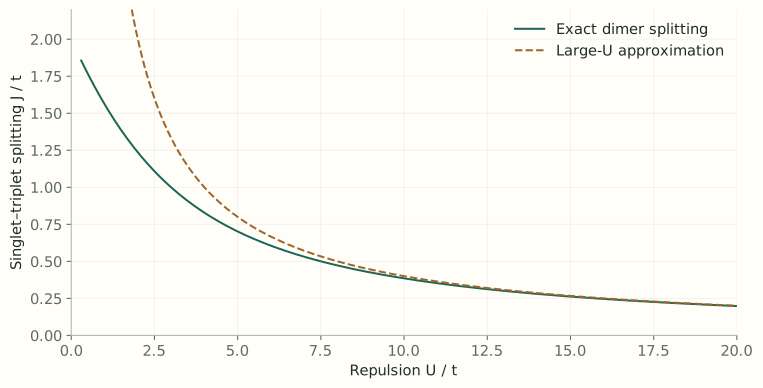
The singlet can lower its energy through virtual double occupancy; the triplet cannot access the same process because of spin and fermionic antisymmetry. This is a microscopic origin of superexchange, an effective antiferromagnetic interaction arising through virtual charge motion.
The exact dimer splitting and $4t^2/U$ approximation. A successful two-site exchange calculation does not establish pair condensation or a transition temperature.
For a separate illustration, divide a Fermi surface into two equally weighted patches. Let the repulsive pairing interaction within a patch be $u$ and between patches be $g$. The linearized pairing kernel is proportional to $-\begin{pmatrix}u&g\\g&u\end{pmatrix}$. The sign-changing vector $(1,-1)$ has eigenvalue proportional to $g-u$, which is positive if interpatch repulsion dominates. Changing the gap sign reduces the cost of the repulsive scattering. Identifying this pattern specifically as $d$-wave requires the full spatial symmetry; two patches alone do not supply it.
Finally, in an appropriate strictly two-dimensional phase model, define the stiffness by the phase-twist free energy $F_\theta=(\rho_s/2)\int d^2x\,|\nabla\theta|^2$, where $\theta$ is the collective phase. Vortices are configurations in which this phase winds around a point. Their unbinding gives the Berezinskii–Kosterlitz–Thouless relation $k_BT_c=\pi\rho_s(T_c^-)/2$. Here $\rho_s$ is the long-wavelength, renormalized stiffness in energy units and $T_c^-$ approaches the transition from below. Layer coupling, electromagnetic effects, and temperature-dependent stiffness must be treated before transferring this relation to a real bulk sample.
Questions to investigate
Calibration questions have established answers. Diagnostics ask what follows inside a specified model or comparison. Extensions are bounded proposals whose novelty and feasibility need a focused literature check. Each answer should record its assumptions and limits.
Does a small-cluster binding energy predict long-distance order?
Do: Compare a defined pair-binding energy with pair-correlation decay across a sequence of small clusters or ladders using the same Hamiltonian.
Check: Fix boundary conditions and particle-number conventions. Pair binding on one cluster is neither necessary nor sufficient evidence for a two-dimensional condensate.
Meaning: Locates the inferential gap between local energetics and a thermodynamic superconducting phase.
Is phase stiffness a ceiling or the actual limiting scale?
Do: In a chosen two-dimensional model, compute or use benchmark values of temperature-dependent stiffness and pairing amplitude. Compare the stiffness transition criterion with the pairing scale.
Check: Use renormalized stiffness near the transition, not only its zero-temperature value. State dimensional and interaction assumptions.
Meaning: Determines the bottleneck in that regime; an upper bound alone cannot establish it. [38]
Which conclusion survives changing the microscopic reduction?
Do: Match a small multi-orbital cluster to a one-band model using low-energy levels. Compare one additional pair or spin observable not used in matching.
Check: Transform observables as well as the Hamiltonian and identify the energy window where discarded states remain separated.
Meaning: Tests transfer of a mechanism across a reduction. It is a bounded continuation of the original cuprate program, with novelty requiring a specific regime and comparison.
SC-1 and SC-2 establish two mechanisms, superexchange and sign-changing pairing, without conflating them. SC-3 then asks the essential next question: which local results persist as the system grows? Use the longer cuprate document for a dedicated program once that boundary is explicit.