Why does interference disappear, and what makes an outcome definite?
For a physicist entering another fieldSources checked 12 September 2026Editable working edition
The guiding question
Which part of a measurement can unitary system–apparatus–environment dynamics explain, and which additional claims lead to experimentally distinct predictions?
Starting knowledge: Superposition, density matrices, and a partial trace. All model states are specified below.
Quantum evolution turns a superposition of input states into a superposition of corresponding apparatus records. If the input is $a|0\rangle+b|1\rangle$, an ideal measuring interaction gives $a|0,A_0\rangle+b|1,A_1\rangle$. The two apparatus states represent distinguishable records. Applying the same linear dynamics to the complete system has not, by itself, selected one term.
Three issues should be separated: why interference between macroscopic alternatives becomes inaccessible, why certain stable records are selected by interactions, and how probabilities and definite outcomes are understood. Decoherence is the loss of locally accessible phase coherence through correlations with unobserved degrees of freedom. It provides a dynamical explanation for the first issue and much of the second. A statement about one actual outcome also requires an account of what the quantum state describes. [30]
What is known, and what is open
Quantum theory is highly successful at predicting measurement statistics, including Bell-inequality violations. Bell tests constrain locally causal hidden-variable descriptions under assumptions including suitable independence of measurement choices. They do not choose among all interpretations of measurement, and they do not allow controllable faster-than-light communication. [32]
Everett-style accounts retain the global state and explain records relative to branches. Bohmian theories add definite configurations guided by the wavefunction. Operational accounts take outcome probabilities as primary. These approaches differ in ontology and explanatory commitments; where they reproduce identical statistics, the difference is not settled by repeating the same experiment.
Objective-collapse models modify dynamics so that superpositions are physically suppressed even for an otherwise isolated system. They can predict effects such as additional heating or loss of interference. Such parameters can be bounded experimentally. The existence of a phenomenological bound does not establish a collapse mechanism. [31]
Build the minimum theory
Start with $|\psi\rangle=a|0\rangle+b|1\rangle$, with $|a|^2+|b|^2=1$, and an environment in $|E_*\rangle$. A controlled interaction produces
The partial trace sums over inaccessible environment outcomes. Orthogonal records have $\gamma=0$, so local interference disappears. The diagonal entries are the usual measurement probabilities, but obtaining that reduced matrix by tracing a pure entangled state is not the same physical preparation as selecting one state and forgetting which. These two preparations agree for system-only measurements while differing for suitable joint measurements.
Worked example: many weak records can erase local interference
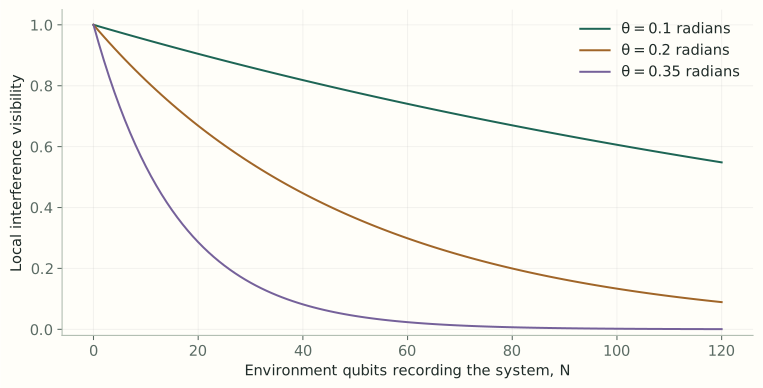
Let each of $N$ initially independent environment qubits record the system weakly:
For equal input amplitudes, local interference visibility is $|\gamma|$, and the reduced eigenvalues are $(1\pm|\gamma|)/2$. Thus many individually weak records can make a system look classical with respect to that record basis. The global state nevertheless remains pure under the assumed unitary interaction.
Exact visibility $|\cos\theta|^N$ in the independent-record model. The curve depicts loss of system-only interference; it does not depict a stochastic selection of an outcome.
In principle, reversing the entire controlled interaction restores the initial coherence. In practice that can require control of an enormous environment. This practical asymmetry is crucial for stable records, but computational difficulty alone is not a logical derivation of an extra collapse law.
Insight. The question “has the superposition disappeared?” must specify the observables and the allowed access. The reduced state and the total state answer different questions.
Questions to investigate
Calibration questions have established answers. Diagnostics ask what follows inside a specified model or comparison. Extensions are bounded proposals whose novelty and feasibility need a focused literature check. Each answer should record its assumptions and limits.
QM-1 · Quantum measurement and classical recordsCalibration
What disappears under a partial trace?
Do: Derive the reduced matrix, visibility, and eigenvalues in the independent-record model. Plot entropy and visibility against $N$.
Check: Recover a pure reduced state at $\theta=0$ and a diagonal reduced state for orthogonal environment records. Global purity remains one.
Meaning: Establishes decoherence precisely without presupposing a particular interpretation of outcomes.
QM-2 · Quantum measurement and classical recordsCalibration
Can local measurements distinguish entanglement from ignorance?
Do: Compare the two-qubit Bell state with the equally weighted mixture of $|00\rangle$ and $|11\rangle$. Compute single-qubit states and the joint correlation $\langle X\otimes X\rangle$.
Check: Both local states equal the identity divided by two, while the correlation is one for the Bell state and zero for the mixture. $X$ flips $0$ and $1$.
Meaning: An exact example of why local diagonality does not identify the global physical state.
QM-4 · Quantum measurement and classical recordsDiagnostic
Which collapse effect is distinguishable from ordinary noise?
Do: Choose one published collapse model and one explicit environmental-noise model. Compare their predicted dependence on mass, separation, and interrogation time.
Check: Fix nuisance parameters using independent information. Agreement at one point does not establish agreement across a controlled scan.
Meaning: Produces a testable model comparison. This is a dynamics question, not a generic experiment deciding all interpretations.
QM-5 · Quantum measurement and classical recordsExtension
How much environmental access is needed to restore interference?
Do: In the independent-record model, reverse the interaction on only $k$ environment qubits. Compute the remaining visibility and compare with the best allowed joint measurement on the accessible part.
Check: Recover full reversal at $k=N$ and ordinary reduced visibility at $k=0$. State which operations and records are available.
Meaning: A tractable access-dependent question. The simple model is established; a worthwhile extension needs a specified correlated environment or operational restriction.
QM-1 and QM-2 should be done together. They establish both the explanatory power of decoherence and the precise inference it does not supply. After that, choose whether the next question is about records, interpretation, or modified dynamics.