Sem II Week 5 — ‘t Hooft Anomalies: Obstruction as Physics
Sem II Week 4 summed a theory over its backgrounds, which required a gauge-invariant partition function (F3 there). This week we study symmetries whose invariance fails by a phase that no local counterterm removes. The phase depends only on how the symmetry acts and on locality, so no symmetric deformation or renormalization-group flow changes it, and it forbids a trivially gapped ground state. We meet it in three finite calculations: a projective representation of , the Lieb–Schultz–Mattis constraint on a spin-1/2 ring threaded by a flux, and the end of the cluster chain, where the bulk one dimension up cancels it. Sem II Week 6 finds the same structure in Yang–Mills theory at θ = π; Sem II Week 7 classifies the bulks.
How to use this chapter
- In class: in the first lecture derive (2.1)–(2.2), then §3 in order: the cocycle condition (3.2), the Pauli cocycle (3.6), the two-dimensional irreducible representation (§3.3), the classification (3.9) and the partition-function form (3.11); Problem 1. In the second, the ring operators (4.2)–(4.4), the flux argument (4.5) with Figure 2 on the board, the anomaly (4.7) and the odd ring (4.8); Problems 2 and 3. In the third, the restricted symmetry of the cluster chain (5.6)–(5.7) with Figure 3, the twisted rings of §5.3, the inflow identity (5.9)–(5.12) and §§6.1–6.2; Problem 4. The seminar hour (§7) is Oshikawa’s letter, presented by the instructor as the model for Block 2.
- For self-study: §6.3, the fine print of §8 and Problems 5⋆–7⋆. The one calculation to do alone is the four-site ring of §4.3 by hand: the six states with , the blocks with and , and their lowest levels followed from φ = 0 to 2π.
- Instructor checkpoint: two errors recur. The first is to call any sign in a product of symmetry operators an anomaly: for one is removed by , and the invariant is the commutator phase of (3.4) (F1). The second is to forget why momentum is conserved during the flux insertion: the uniform gauge (4.1) keeps every translation invariant, and the shift comes entirely from (4.4), whose boundary factor is 1 because occupations are integers.
0. Reading
Primary: Oshikawa, Phys. Rev. Lett. 84 (2000) 1535, the whole letter (the seminar of §7). Gaiotto, Kapustin, Komargodski, Seiberg (GKKS), arXiv:1703.00501, App. D.1: ‘t Hooft anomalies in quantum mechanics as projective representations (Problem 6⋆).
Secondary: Cheng & Seiberg, SciPost Phys. 15 (2023) 051 [arXiv:2211.12543], for the viewpoint of §§4–6, in which the symmetries of twisted Hilbert spaces and their representations capture the anomaly. Lieb, Schultz, Mattis (LSM), Ann. Phys. 16 (1961) 407, and Hastings, Phys. Rev. B 69 (2004) 104431 [cond-mat/0305505], for the theorems (statements). Else & Nayak, Phys. Rev. B 90 (2014) 235137 [arXiv:1409.5436], for the edge restriction of §5.2; Chen, Gu, Liu, Wen (CGLW), arXiv:1106.4772, for the classification statements of §§5.4 and 6.3. From the course: Sem II Week 4 §§2, 5 and F3; Sem I Week 4 §3.4; Sem II Week 2 §§3.3–3.4; McGreevy, arXiv:2204.03045, as the companion review.
Optional research reading: ‘t Hooft, NATO Sci. Ser. B 59 (1980) 135 (Cargèse 1979), for anomaly matching; Callan & Harvey, Nucl. Phys. B 250 (1985) 427, for inflow; Ogata, Tachikawa, Tasaki (OTT), Commun. Math. Phys. 385 (2021) 79 [arXiv:2004.06458], for §4.5; Briegel & Raussendorf, Phys. Rev. Lett. 86 (2001) 910 [quant-ph/0004051], for the cluster state; Majumdar & Ghosh, J. Math. Phys. 10 (1969) 1388, for Problem 7⋆; Tachikawa, arXiv:1712.09542, for §6.3.
Proof-status labels as in Sem I Week 1. Every sign and normalization is from conventions: the projective-representation conventions (3.1)–(3.4) and the SPT weight and edge rule (5.8), (5.11) are recorded in its §6, the twisted ring (4.1)–(4.2) and the cluster chain (5.1)–(5.2) in its §4. Every matrix identity below was checked with explicit Pauli matrices on the sizes named where it is used.
1. Motivation and setting
A symmetry usually says little about the low-energy physics of a local Hamiltonian: a symmetric chain can be gapless, break the symmetry, or be a paramagnet with a unique gapped ground state, depending on the couplings. Translation-invariant chains of spins 1/2 with spin-rotation symmetry are different. The Heisenberg chain is gapless and the Majumdar–Ghosh chain has two dimerized ground states (Problem 7⋆), but a unique gapped ground state never occurs: Lieb, Schultz and Mattis proved in 1961 that for isotropic interactions a state orthogonal to the ground state has an excitation energy that vanishes as the chain grows, and OTT exclude a unique gapped ground state for every such chain (§4.5). Likewise each end of an open cluster chain carries a qubit that no symmetric perturbation near that end polarizes, and in the gauged chain of Sem II Week 4 §5.2 the residual symmetry squares to on a twisted sector.
The three are one phenomenon, an ‘t Hooft anomaly (t-hooft-anomaly): the symmetry cannot be coupled to backgrounds with a gauge-invariant partition function, and no local redefinition repairs this. We define it (§2), compute it in the smallest case (§3), find it in spin chains (§4), cancel it from one dimension up (§5) and turn it into a constraint (§6), always in finite dimensions; the anomalies of chiral fermions, where the subject began (§10), have the same structure.
2. What an ‘t Hooft anomaly is [Definitions; the remarks Proved.]
Let a theory on a closed spacetime have a symmetry , with partition function in a background : a cocycle for (Sem II Week 4 (2.2)), a flat connection for , and in Hamiltonian language twisted boundary conditions and symmetry insertions (Sem I Week 4 §3.4). A background gauge transformation moves the defects without changing their classes. The models of Sem II Week 4 were invariant, (2.3) there; in general
where is a local functional of and λ. The partition function is defined only up to local counterterms, , with a local functional of the background alone, such as a phase per junction of defects or with integer ; they express the freedom in defining the symmetry operators near their junctions, the counterterm of a finite symmetry operator in Sem II Week 1 §2.2, and they change
Definition. has an ‘t Hooft anomaly if no local counterterm makes vanish; the anomaly is the class of modulo (2.2).
Three remarks. (i) The symmetry is exact, and the theory without backgrounds is untouched. (ii) An anomalous symmetry cannot be gauged: with the sum (2.4) of Sem II Week 4 depends on the representatives (F3 there). (iii) The anomaly is computed from the symmetry operators and their locality, so all Hamiltonians with the same symmetry operators share it, the root of matching (§6); §5.4 shows, in the simplest case, that (2.1) is the boundary variation of a gauge-invariant theory one dimension up.
3. Projective quantum mechanics
3.1 Projective representations and their cocycles [Proved.]
A projective representation of on is a set of unitaries with
normalized by , so . Associativity gives and , so
the 2-cocycle condition. Rephasing , , changes
Cocycles modulo coboundaries form , whose product is the tensor product of representations. For abelian , δβ is symmetric, so the commutator phase
depends only on the class. It is bimultiplicative: and give , and , .
3.2 The Pauli cocycle [Computed.]
Write , , and set on
with the Pauli matrices. Since and ,
With rows and columns ordered , the rows of and are and those of and are . Being bilinear, (3.6) satisfies (3.2) identically, and , with . Compare , the cocycle of , with : it is symmetric and equals δβ for , so a sign in is removed by rephasing, and the invariant content is . We checked the sixteen entries of (3.6) and the 64 instances of (3.2) with Pauli matrices; of the 16 normalized ±1-valued cocycles, in 8 classes modulo ±1-valued coboundaries, the 8 symmetric ones are coboundaries with β in and the 8 with are not.
3.3 The irreducible representation is two-dimensional [Proved.]
Let have , rephased so that (possible since is a number for ). (i) There is no one-dimensional representation, since numbers commute. (ii) , so the eigenvalues of have equal multiplicity and . (iii) maps the eigenspace of onto , since . With an orthonormal basis of and , so that , the basis , gives
Every representation in the class is copies of (3.5), the unique irreducible one, which is two-dimensional. If for all , commutes with and , which generate all matrices on the second factor, so
with on : every level is at least doubly degenerate, a symmetric perturbation cannot split the doublets, and for , with . The torus degeneracy of gauge theory (Sem II Week 2 §§3.3–3.4) has the same origin: the holonomies obey , a projective representation of whose irreducible representation is -dimensional (Problem 1).
3.4 [Proved.]
The map is well defined (§3.1), a homomorphism, and onto (the trivial representation gives , (3.5) gives ). It is one-to-one. If , ω is symmetric, and the algebra with basis and product is associative by (3.2) and commutative. Left multiplications by the then have a common eigenvector, , with because is invertible, and
so ; since , is a homomorphism of a finite group into the positive reals, so and . Therefore
The enumeration of §3.2 shows the same collapse: the 8 classes of fall into two according to . The argument holds for every finite abelian group (Problem 1).
3.5 The anomaly in background language [Proved.]
On a Euclidean time circle of length β cut into steps of length ε, a background is a -valued 1-cochain on the time links (flat in one dimension), and
with gauge transformations , . Since , ; for a linear representation this depends only on the holonomy, so gauge-equivalent backgrounds agree. Here a nontrivial holonomy gives , by in (3.8), so the test uses backgrounds with trivial holonomy. Take two backgrounds whose only nontrivial links are four insertions, consecutive ones separated by at least identity links (so ), in the time orders and . Both have trivial holonomy and are therefore gauge equivalent, and since while ,
The relative sign is a non-local function of the links, fixed by the order of insertions arbitrarily far apart: it is the class at work. A local counterterm of range is a product of factors over windows of consecutive links; with the insertions this far apart each window contains at most one of them, both backgrounds contain the same windows, and the counterterm multiplies both by the same number. For adjacent insertions, and on four links, the pair counterterm , all other , does absorb the sign; the statement is that no local counterterm makes all gauge-equivalent backgrounds agree. The d ‘t Hooft anomaly of is therefore the class , since a coboundary is removed by the counterterm per link, and for the nontrivial class is (3.5). Gauging fails with it: in quantum mechanics gauging projects onto states with for all , the Gauss law of Sem II Week 4 §3.1, and admits none.
4. Lieb–Schultz–Mattis as a mixed anomaly
4.1 The ring and its operators [Proved.]
Take spins 1/2 on a ring, , , with , occupations , charge and filling . The acts by , translation by (conventions §4), and momentum is defined by . In a background flux φ, in the uniform gauge of Figure 1,
where , Δ is the anisotropy (Δ = 1 for the Heisenberg chain), and a hop from to picks up , so the holonomy is : the link phases of Sem I Week 7 frozen into a flat background, and the flux of Laughlin’s argument. Every link carries the same phase, so for all φ, and is conserved.
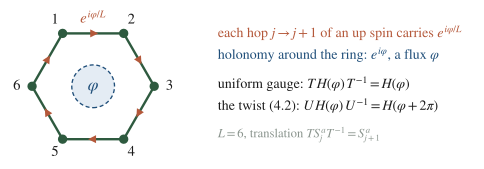
Figure 1. The six-site ring in a flux φ, uniform gauge (4.1): each hop of an up spin carries , the holonomy is , is translation invariant, and the twist of (4.2) maps to .
The large gauge transformation is
with . On a link with the hop acquires , and on it acquires as well, so
and the background is the holonomy : a flux is gauge trivial. Relabeling , with the site carrying weight ,
because . The half-integer spin enters here: with in place of the boundary factor is , and with the offset in gives the same sign (Problem 3 treats spin ).
4.2 Flux threading [the operator steps Proved; the conclusion Heuristic; the theorems Stated — refs: LSM; Hastings]
Let be a ground state of with and momentum , and let φ grow slowly from 0 to . The evolution operator commutes with and , because every does, so the final state has momentum and, if the evolution is adiabatic, is an eigenstate of . By (4.3), is an eigenstate of with the same energy, and by (4.4), , so
For , has a different momentum and is orthogonal to . If had a unique ground state with a gap that stays open along the path, would be the ground state of , that of , and , a contradiction. So at fractional filling, for instance spins 1/2 at , where ν = 1/2 and the shift is π, no unique ground state has a gap that survives the insertion. On a finite ring the gap closes along the path through a crossing of levels with different momenta (Figure 2). The physical input [Heuristic] is that a flux through a large ring is invisible to local operators, so in a gapped phase it moves the low-lying spectrum by an amount that vanishes as ; then becomes a second ground state, and the system is gapless or degenerate. For in lowest terms, insertions give the momenta , : a gapped phase has at least ground states. LSM proved the spin-1/2 statement without the adiabatic assumption (Problem 5⋆), and Hastings the higher-dimensional one [Stated — refs].
4.3 The six-site ring [Computed.]
For , , (20 states with ) the ground state is unique, with and ; the lowest level is . As φ grows (Figure 2) the ground-state level rises to at , the lowest level falls to , and they cross at φ = π at . Inside the sector the followed level stays at least below the next one, the minimum being reached at , so the evolution in the sector is adiabatic, and has and energy , the lowest eigenvalue of . We checked (4.3), (4.4) and to machine precision for , and the flow for the other sizes: for from () to the level at , crossing at ; for from to .
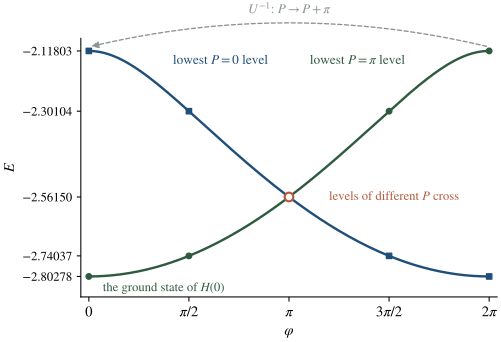
Figure 2. Spectral flow on the six-site Heisenberg ring at : the flux carries the ground state () to the lowest level of , which maps to the lowest level of ; the crossing at φ = π is allowed because the momenta differ. Computed by exact diagonalization of (4.1) at in the two momentum sectors; the marked points, at φ/π = 0, ½, 1, 3/2, 2, take the values on the energy axis.
4.4 The anomaly as a phase of the partition function [Proved.]
Put the ring on a Euclidean torus with holonomy around space and a translation twist around time,
From (4.4), , and with (4.3) and cyclicity
Gauge-equivalent backgrounds give partition functions that differ by . A compensating counterterm would couple the spatial holonomy to the temporal translation twist, a factor per unit of twist; it is a function of only for , and then contributes to the ratio. Redefining or by functions of , or moving the origin of in (4.2), which multiplies by , leaves (4.4) and (4.7) unchanged. The phase is a mixed anomaly of and translation, labeled by ν mod 1. We checked (4.7) at β = 1 for , where the ratio is .
4.5 Without : the odd ring [Proved; the theorem Stated — refs: OTT]
The π rotations , generated by and (up to an irrelevant ), act on each site by (3.5), the nontrivial class of (3.9). Each site contributes one sign to the commutator, so
For odd the Hilbert space carries the nontrivial class, and by §3.3 every -symmetric Hamiltonian, translation invariant or not, has an exactly doubly degenerate spectrum: on five sites with independent random symmetric two- and three-spin couplings on every bond all 32 levels pair exactly, while on six sites the same construction is generically nondegenerate. For even nothing is forced, and a chain with alternating bonds, whose two-spin unit cell carries the trivial class, can have a unique gapped ground state. With translation by one site, a projective class per unit cell forbids a unique gapped ground state of the infinite chain: the translation-invariant theorem of OTT, proved by operator-algebraic methods built on projective representations [Stated — refs]. Equation (4.8) is its finite-size face: one extra site inserts a unit of translation around space, and each unit carries one copy of the on-site class, as each flux carries the momentum in (4.5) [Heuristic; reading the odd ring as a translation-twisted sector is the course’s interpretation].
5. Inflow in the simplest case: the cluster chain
5.1 The chain and its symmetry [Proved.]
On a ring of even length put a qubit per site, with Pauli operators (the of conventions §4), and take
and overlap in two anticommuting pairs and commute, other pairs commute trivially, and . The symmetry is generated by
For odd the two of sit on even sites, so commutes with and picks two signs under ; even is the same with . Each even site appears in the two with odd next to it, and the ‘s square away:
The ground state is the unique state with all , the cluster state of Briegel and Raussendorf, with gap 2 and . The symmetry acts on-site and linearly, so the closed chain has no anomaly; it is a symmetry-protected topological phase (spt-phases), whose content appears at a boundary.
5.2 The symmetry restricted to an open chain [Computed; the higher orders of perturbation theory Sketched]
Cut the ring between and 1:
The independent stabilizers on qubits leave a ground space of dimension 4, with gap 2. Four operators commute with every of (5.4),
( meets in two anticommuting pairs); each pair anticommutes and the left pair commutes with the right one, so they are the Pauli operators of two edge qubits. To restrict the symmetry, the method of Else and Nayak in its simplest case, use the exact identity , , for every odd in , where the factors telescope to (Figure 3), and for every even in :
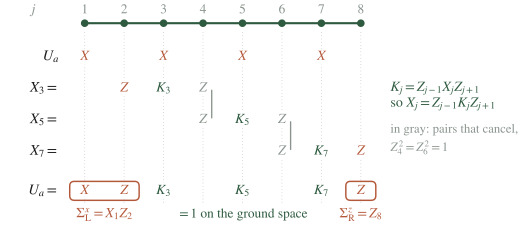
Figure 3. The telescoping (5.6) on eight sites: each bulk is traded for its stabilizer and two ‘s, which cancel in pairs, and one operator survives at each edge.
On the ground space all , and the symmetry is a product of edge operators,
At each edge : the left edge carries (3.5) exactly, the right edge the same class with and exchanged, and the two signs cancel in ; the four ground states carry the charges once each. We checked (5.3), (5.5) and (5.6) as operator identities on eight sites, and (5.7) on the ground space.
Each edge is an anomalous quantum mechanics (§3.5), which protects it. A symmetric perturbation near the left edge generates, at orders well below , an effective operator on the left qubit that commutes with and , which generate all matrices, so it is a multiple of the identity; only processes reaching across the chain split the doublets [Sketched; the general argument, with matrix-product states, is Sem II Week 7]. Adding the symmetric splits the four lowest levels by 0.217, 0.102, 0.048 and 0.023 for , while , which breaks , splits them by 0.200 at every [Computed by exact diagonalization].
5.3 The bulk response [Computed.]
The bulk partner of the edge class appears on the twisted ring. A -twist between and 1 identifies , which is on even sites; only contains such a across the cut, with , so . Its unique ground state has , all other , and by the operator identity (5.3) . The -twist flips and gives : a -defect carries -charge and an -defect carries -charge. On the torus with holonomies of and of the low-temperature partition function is for around time and around space, the same with , and when both run along the same cycle. This is the response
with the cup product of conventions §8: for on the time links of one slice and on the space links of one column, ; for the reverse assignment, ; with both holonomies in space, 0. We checked the three twisted rings on eight sites and the cup sums on a torus. On a closed surface (5.8) is gauge invariant, since for closed (Leibniz, conventions §8).
5.4 Inflow as a cochain identity [Proved.]
The open chain lives on the cylinder , whose boundary is the two edge worldlines (Figure 4). For closed and , the sum of over the plaquettes reduces to the time links of the boundary circles, with , so
and, signs being irrelevant mod 2,
The edge partition function is (3.10) with transition operators , later times to the left. Conjugating each by the gauge transformations at its ends, , leaves the trace unchanged, since neighbouring factors combine into ; moving through costs , and what remains is at . Therefore
for both edges, since in (5.7), and each boundary factor of (5.10) is cancelled by its edge:
For the same steps give , with α at the tails of the boundary links. This is inflow in its simplest case: each edge is an anomalous d theory, and its anomaly is the boundary variation of the d SPT. We checked (5.9) and its partner for 200 random closed integer cochains on a cylinder, and (5.11) for both edge orientations of (5.7) on about a hundred random backgrounds with trivial holonomies, since vanishes otherwise (§3.3).
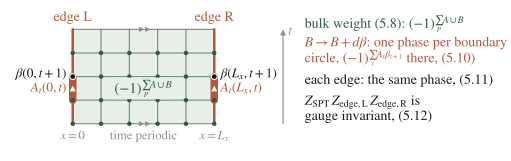
Figure 4. Inflow on the cylinder: under the bulk weight (5.8) changes by one phase on each boundary circle, (5.10), each edge produces the same phase, (5.11), and the product (5.12) is invariant.
For bosonic theories with finite , the anomalies of -dimensional theories and the SPT phases in dimensions are both described, in the group-cohomology construction, by ((3.9) for ), and each SPT’s boundary realizes the corresponding anomaly [Stated — refs: CGLW; Else–Nayak; Callan–Harvey for continuous symmetries and fermions]. Sem II Week 7 classifies the d bulks by , with (5.6)–(5.7) as its explicit example.
6. Anomaly matching
6.1 The statement and the spectator argument [Model proof in dimensions; the general case Sketched]
Anomaly matching. If a local theory with symmetry and anomaly α is deformed by -symmetric local terms, or flows under the renormalization group, with realized at every stage, the resulting theory has the same anomaly α.
In quantum mechanics this is immediate: if commutes with a fixed projective for all λ, every eigenspace carries the class (3.9) and every level is degenerate for every λ (§3.3), since the deformation never touches the [Proved]. In field theory ‘t Hooft’s argument adds a decoupled spectator sector with anomaly . The total is anomaly free, so can be coupled to a dynamical gauge field with arbitrarily small coupling, and the gauged theory is consistent at every scale; in the infrared, gauge invariance requires the anomaly of the infrared sector to cancel that of , which a free or topological spectator keeps fixed, so it is α [Sketched]. In the inflow form the spectator is the SPT of §5.4, and the flow acts locally on the boundary without changing the gapped bulk response [Sketched].
The spectator has an exact d model [Proved]. The left edge qubit of §5.2 cannot be gauged (§3.5). A spectator qubit with the inverse class, here the same class, makes and commute, and the Gauss law has the unique solution . On the open cluster chain the right edge is the spectator of the left one: and commute because the two edge classes cancel through the bulk, (5.7).
6.2 What a nonzero anomaly allows [Proved, granting that a unique gapped ground state flows to an invertible theory]
If α ≠ 0 the infrared cannot be trivially gapped, with a unique ground state and a gap on every closed spatial manifold and unbroken: such a theory flows to an invertible theory, whose partition function is a local functional of the background, like (5.8), so its variation (2.1) is removed by the counterterm . Three options remain: (a) gapless, as the Heisenberg chain; (b) spontaneous breaking of part of the symmetry, as the Majumdar–Ghosh chain, whose ground states at momenta 0 and π break translation (Problem 7⋆), and the gauged chain of §6.3; (c) in , topological order with fractionalized symmetry, the subject of Block 3. Matching constrains the infrared without fixing it; which option occurs depends on the couplings.
6.3 The chain of Sem II Week 4, recognized [the anomaly Stated — refs: Tachikawa; the signature Computed in Sem II Week 4]
In the gauged chain of Sem II Week 4 §5.2 the residual , generated by , and the dual , generated by , have a mixed anomaly because does not split [Stated — refs: Tachikawa], with the signature on the dual-twisted sector, (5.2) there. Note what is invariant. Inside that sector the sign could be absorbed by , since , and commutes with there; what survives is the comparison between sectors, since is one operator, the same local formula on all of them, and is the gauge transformation , fixed on each sector by the Gauss law. A d anomaly concerns the action of the symmetry across twisted sectors, which is why its classes are 3-cocycles, for bosonic theories with finite [Stated — refs: CGLW; Else–Nayak], and Problem 4 checks at the soluble points that the gauged chain has no symmetric trivially gapped phase. In every case of this week one symmetry acts with a modified group law on the sector twisted by another (the commutator (3.4) on the edge qubit, the momentum shift (4.5) after a flux , the commutator (4.8) on the odd ring, here), which is the viewpoint of Cheng and Seiberg.
7. Seminar: Oshikawa (2000), presented by the instructor
Format. The first seminar of Block 2, presented by the instructor as the model in the format of syllabus §7. Students read the letter and bring Problem 3.
Sections. The whole letter, Phys. Rev. Lett. 84 (2000) 1535, four pages.
The technical claim. For particles with a conserved number on a periodic lattice, in any dimension and for any interaction and statistics, a finite gap above a unique ground state is possible only when the number of particles per unit cell is an integer, and at a gapped phase has at least degenerate ground states; the argument combines the LSM construction with Laughlin’s flux insertion.
What it needs from Semester I. Twisted sectors (Sem I Week 4 §3.4) and link phases as a gauge field (Sem I Week 7), with §§4.1–4.2 of this note.
The step at the board. The higher-dimensional (4.4)–(4.5): on an torus, gives , a shift , so at the transverse size needs to produce distinct momenta.
For the discussion. Where the gap assumption enters (§4.2, F3) and how LSM (Problem 5⋆) and Hastings avoid it; in the states need not break any symmetry, which leads to Block 3.
The open question it leaves for this course. Constraints with no to thread: the case of §4.5 (OTT) and its inflow from dimensions (Problem 8⋆⋆).
On the course map. The anomaly is the failure of to depend only on the classes of its backgrounds, (4.7); Sem II Week 6 finds the same failure for the background of Yang–Mills theory at θ = π.
8. Subtleties and fine print
F1 — Not every sign is an anomaly. : a projective representation of a cyclic group becomes linear after rephasing its generator. The π rotation of a spin 1/2 squares to , , which alone means nothing; the anomaly of §4.5 is the commutator of two π rotations, the face of the spin-1/2 class of .
F2 — Odd rings are exact, even rings need translation. The degeneracy (4.8) needs no translation invariance, while on even rings the on-site class constrains only chains invariant under translation by one site (§4.5).
F3 — The adiabatic assumption. The conclusion of §4.2 needs the gap to stay open during the insertion in the thermodynamic limit, an assumption that LSM’s variational state (Problem 5⋆) and Hastings’s quasi-adiabatic continuation avoid [Stated — refs].
F4 — Edge protection is symmetric. Each alone is anomaly free, so a field breaking either one splits the edge doublets of §5.2 at first order; only the pair has .
F5 — Translation is not an internal symmetry. The anomaly of §4 involves a spatial symmetry, which (4.6) treats as a twist in the trace and §4.5 through the length of the ring. Matching applies to its action on the low-energy theory, where lattice translation can act as an internal symmetry; Cheng and Seiberg analyze when and how [Stated — refs].
9. Common misconceptions
“An anomalous symmetry is broken by quantum effects.” Tempting because the axial symmetry of QED is broken by its anomaly, which involves the dynamical gauge field. An ‘t Hooft anomaly concerns an exact global symmetry whose operators commute with the Hamiltonian; the obstruction appears only in coupling it to backgrounds or gauging it (§2).
“A projective representation is a matter of phase conventions and can always be made linear.” Tempting because of (3.3). Rephasing removes only coboundaries; is invariant (§3.1), and the class (3.5) forces the doublets of §3.3.
“Lieb–Schultz–Mattis says that a chain of half-integer spins is gapless.” Tempting because the 1961 paper concluded that there is no gap, and the Heisenberg chain is gapless. The theorem excludes a unique gapped ground state; the gapped, doubly degenerate Majumdar–Ghosh chain is allowed (§6.2, Problem 7⋆).
10. Historical note
Lieb, Schultz and Mattis (1961) solved two models of an antiferromagnetic chain exactly by rewriting the spins as fermions, and showed, with the twist operator (4.2), that for spin-1/2 chains with rather general isotropic Heisenberg interactions the ground state is nondegenerate with no gap above it; that the low-lying twisted state may instead become a second ground state was understood later, and the chain Majumdar and Ghosh had solved in 1969 realizes it. ‘t Hooft formulated anomaly matching in his Cargèse lectures of 1979 (published 1980) to constrain massless composite fermions, which must reproduce the triangle anomalies of the global symmetries of their constituents; he argued by weakly gauging those symmetries, with spectator fermions cancelling the anomaly. Callan and Harvey (1985) showed that the anomalies of chiral zero modes on strings and domain walls are cancelled by a flow of charge from the bulk, the inflow of §5.4; Cheng and Seiberg review how the lattice constraints fit the same definition.
11. What to take away
- An anomaly is an obstruction modulo counterterms, (2.1)–(2.2). The symmetry is exact; what fails is its coupling to backgrounds, and with it gauging.
- In quantum mechanics it is a projective class. , detected by the commutator phase (3.9); the nontrivial class forces two-dimensional irreducible representations (3.7) and doublets that no symmetric perturbation lifts (3.8).
- Lieb–Schultz–Mattis is a mixed anomaly. Translation fails to commute with the large gauge transformation, (4.4): a flux shifts the momentum by , (4.5), and the torus partition function by , (4.7); without the on-site class does the same, (4.8). Physically, a half-filled ring remembers a flux quantum that no local probe sees.
- Inflow. Restricted to an open cluster chain, the symmetry is a product of projective edge operators, (5.6)–(5.7), and the bulk response (5.8) varies on the boundary by exactly the edge phases, (5.10)–(5.12).
- Matching. The anomaly survives symmetric deformations and renormalization (§6.1) and excludes a trivially gapped phase: the infrared is gapless, breaks a symmetry, or, for , is topologically ordered (§6.2).
12. Looking ahead: Sem II Weeks 6 and 7
Sem II Week 6 turns on the background of four-dimensional Yang–Mills theory and finds at θ = π a phase of the type (4.7): with a 2-form background, θ → θ + 2π shifts the partition function by a fractional instanton number that no counterterm compatible with time reversal removes, and matching excludes a trivially gapped, time-reversal-invariant confining vacuum; Problem 6⋆ is its quantum-mechanical shadow. Sem II Week 7 turns §5 around: it classifies the d bulks by with matrix-product states, computes the AKLT edge doublet, and builds the d Dijkgraaf–Witten theories, whose boundaries carry the d anomalies of §6.3.
13. Problem set
Routing: Problems 1–4 are the classroom core, 5⋆–7⋆ are self-study consolidation, and 8⋆⋆–9⋆⋆ are research extensions.
Core problems
1. Projective representations of . (Extends §§3.1–3.4.) Show that , detected by , with class realized by , (clock and shift of conventions §4). Find the dimension of the irreducible representations of class and how many are inequivalent, and list them for .
2. π rotations of a spin . (Extends §4.5.) With , , compute and , and decide for which and ring lengths every -symmetric Hamiltonian has an exactly degenerate spectrum. What follows for a two-leg ladder of spins 1/2 with rungs?
3. Flux threading at spin and magnetization . (Extends §§4.1–4.2.) For spins , with of the form (4.1), and , compute and the momentum shift of the flux-threaded state. For which is a unique gapped ground state allowed? Apply this to at and , to at , and to .
4. The gauged chain obeys matching. (Extends §6.3 with Sem II Week 4 §5.2.) For the gauged chain of Sem II Week 4 §5.2 on sites, find the physical ground states at and, to leading order, as , with their eigenvalues of and . Show that neither limit is trivially gapped and say which is broken in each.
Starred problems
5⋆. The LSM variational state. (Extends §4.2 without the adiabatic assumption.) For (4.1) at φ = 0 and , show that are orthogonal to and that , with the hopping part of (4.1). Hint: by (4.3); averaging the two signs cancels the terms in , and . On six sites the left side is 0.934 and the bound 1.645.
6⋆. The particle on a circle at θ = π. (Extends §3 to a continuous symmetry; GKKS App. D.1.) For , , with , take at θ = π the shift and . Show that and generate the projective of (3.5), so every level is doubly degenerate; that at θ = 0, with , they commute and the ground state is unique; and that no rephasing makes the group generated by and a linear representation of . Hint: ; for the last part restrict to the subgroup of the first.
7⋆. The degenerate option: Majumdar–Ghosh. (Extends §§4.2 and 6.2.) For on an even ring, show that the dimer state (singlets on ) and are ground states with , that , and that have momenta 0 and π, the pair (4.5) predicts. Hint: ; bound each triple by its spin-1/2 value. On six and eight sites the ground space is exactly two-dimensional, with gaps and .
⋆⋆ problems
8⋆⋆. The inflow of the LSM anomaly. Known: a translation-invariant chain whose on-site symmetry acts projectively has no unique gapped ground state (OTT); lattice anomalies involving translation are captured by twisted Hilbert spaces (Cheng–Seiberg). Explored: a stack of cluster chains along , each ending on the line , puts one edge qubit with the class (5.7) per chain on that line, the on-site content of §4.5, with translation along the boundary acting as translation of the stack. Build the boundary symmetry operators from (5.6), recover (4.8) for an odd number of chains around a periodic , and find the d response that cancels the boundary anomaly. Sources: §§4.5 and 5; OTT; Cheng–Seiberg; Else–Nayak. Completion: an explicit two-dimensional model with its boundary operators, the twisted-sector computation on small lattices, and a cochain formula for the bulk response with a translation background, checked numerically.
9⋆⋆. Flux threading in two dimensions. Known: on an torus the shift is (§7), so at a gapped phase needs at least ground states when [Heuristic, Oshikawa; theorem, Hastings], and they need not break any symmetry. Explored: how the momenta relate to the torus degeneracy of a topological phase, for instance the -matrix states of Sem II Week 10 with . Sources: Oshikawa; Hastings; Sem II Weeks 8 and 10. Completion: for one gapped model at fractional filling, a check that the insertion permutes its torus ground states with momenta , and what happens when .
Self-study answer checkpoints
Problem 1. Decisive step: is bimultiplicative (§3.1), so it is fixed by , with ; injectivity is the commutative-algebra argument of §3.4 unchanged. Result: , , realized by , , since gives . Class has irreducible representations of dimension , of them inequivalent: the with for all form a subgroup of that order, and . For : , sixteen one-dimensional; , one four-dimensional (the pair , itself); , four two-dimensional, , with Pauli matrices, , distinguished by , . On , and split into inequivalent irreducible pieces, the eigenspaces of the central (checked for ). Common failure: expecting dimension for every , or taking , which realizes the class .
Problem 2. Decisive step: , so . Result: and (checked for ). On a ring the commutator is : exact degeneracy for every symmetric Hamiltonian if and only if is half-integer and odd; integer-spin rings and all even rings are unconstrained. A two-leg ladder has spins and commutator , and each rung carries the trivial class, so §4.5 does not constrain translation along the ladder. Common failure: reading for spin 1/2 as an anomaly (F1).
Problem 3. Decisive step: is an integer, so (4.4) holds unchanged with . Result: the shift is mod , since ; a unique gapped ground state requires , and for in lowest terms a gapped phase has at least ground states. , : π (§4.2); , : , at least three states (checked on six sites, ); , : no constraint, room for the gapped spin-1 chain of Sem II Week 7; : no constraint, and the saturated state is unique. Common failure: writing (4.2) with and dropping the boundary factor , which is where the half-integer spin enters.
Problem 4. Decisive step: at the energy requires mod 4 on every bond with ; for each value of the Gauss operators act freely and transitively on these configurations, leaving one physical state. Result: at , two ground states at , exchanged by (), with on both because the bond differences add up to a multiple of 4: residual broken, dual unbroken. As , at leading order, with all and, by the Gauss law with , all link values equal: two states exchanged by , with , so the dual is broken. On three sites the pair is exactly degenerate and the large- pair is split by at , of order . Neither limit is trivially gapped. Common failure: ignoring the Gauss law, which gives the four ground states of the ungauged ferromagnet at and the unique paramagnet as .
Notes prepared for the generalized-symmetries course, Semester II Block 2. Written to the note-quality-template standard on 2026-10-02. Last revised 2026-10-02.