Sem II Week 9 — Long-Range Entanglement and Error Correction
Sem II Week 8 solved the toric-code. This week asks what kind of state its ground state is and what its degeneracy is good for. We define long-range entanglement by local-unitary circuits and prove that no shallow circuit prepares a toric-code ground state from a product state; we carry out the Schmidt decomposition across a disk, , and isolate the constant with the constructions of Kitaev–Preskill and of Levin–Wen, ; and we read the ground space as a memory, with logical operators as homology classes, the distance, the planar code, and decoding as a random-bond Ising model. Sem II Week 10 carries γ to the quantum doubles.
How to use this chapter
- In class: first hour, the light cone (2.1)–(2.3), the definition (2.4), the theorem (2.5) and the Schmidt decomposition of a group state (3.1)–(3.4); Problem 1. Second hour, the boundary counting (3.5)–(3.8) with Figure 1, Kitaev–Preskill (4.1)–(4.2) with Figure 2 and Table 1, and Levin–Wen (4.3)–(4.4) with Figure 3; Problem 2. Third hour, the distance (5.2)–(5.3), recovery (5.4), the planar code (5.6)–(5.8) with Figure 4, and the random-bond Ising model (6.1)–(6.5) with Figure 5 and §6.3; Problems 3 and 4. The seminar (§8) is Kitaev–Preskill and Levin–Wen.
- For self-study: §§3.4, 4.4, 5.4, 6.4–6.5, §9 and Problems 5⋆–7⋆. Mini-calculation 3 (§7) is due at the end of the week; the calculation to do alone is its Sub-task 1.
- Instructor checkpoint: two errors recur. One is reading γ off a single region, whose constant depends on the boundary count (F3); even the combinations (4.1) and (4.4) need regions in which no star touches four of them (Problem 2). The other is taking the distance for the threshold (§10, third item).
0. Reading
Primary: Kitaev, Preskill (KP), Phys. Rev. Lett. 96 (2006) 110404 [hep-th/0510092], and Levin, Wen (LW), Phys. Rev. Lett. 96 (2006) 110405 [cond-mat/0510613], both in full; Chen, Gu, Wen (CGW), Phys. Rev. B 82 (2010) 155138 [arXiv:1004.3835], §§II–V; Dennis, Kitaev, Landahl, Preskill (DKLP), “Topological quantum memory”, J. Math. Phys. 43 (2002) 4452 [quant-ph/0110143], §§I, III.A–B and IV, eqs. (41)–(43).
Secondary: Hamma, Ionicioiu, Zanardi (HIZ), Phys. Rev. A 71 (2005) 022315 [quant-ph/0409073]; Bravyi, Kitaev, quant-ph/9811052 (planar codes); Bravyi, Hastings, Verstraete (BHV), Phys. Rev. Lett. 97 (2006) 050401 [quant-ph/0603121]. Course: Sem II Week 8 §§2–5, 7.2; Sem II Week 7 §§4.3, 4.6; Sem II Week 3 §2; Sem I Week 4 §3.4; Sem I Week 5 §7.
Optional research reading: Honecker, Picco, Pujol (HPP), Phys. Rev. Lett. 87 (2001) 047201 [cond-mat/0010143]; Wang, Harrington, Preskill (WHP), Ann. Phys. 303 (2003) 31 [quant-ph/0207088]; Bravyi, Hastings, Michalakis (BHM), J. Math. Phys. 51 (2010) 093512 [arXiv:1001.0344]; Zou, Haah, Phys. Rev. B 94 (2016) 075151 [arXiv:1604.06101]; Preskill, Lecture Notes, ch. 9.
Proof-status labels as in note-quality-template §4; lattice labels, logical operators and the natural logarithm from conventions §9. Every entropy, Schmidt spectrum, distance and decoding count was checked by script, with exact ranks over or explicit state vectors, named where used.
1. Motivation and setting
Week 8 leaves two questions. The first is what distinguishes the toric-code ground state from a paramagnet, when no local order parameter exists (Sem I Week 5) and the 1-form symmetries of Sem II Week 3 are exact only at the solvable point (Week 8 F5). CGW answer from the wavefunction alone: topological-order is entanglement that no circuit of bounded depth removes. KP and LW extract a number from it, the constant in the entropy of a disk. The second question is how good the degenerate ground space is as a memory, and DKLP answer it with statistical mechanics. The setting and notation are those of Week 8 (3.1)–(3.11): the torus, qubits, stars, the stabilizer group and the code space .
2. Local-unitary circuits and long-range entanglement
2.1 Circuits and light cones [Proved.]
Place the qubits at the link midpoints and measure distances with the maximum norm on the torus. Following CGW §V, a layer of range is a product of unitaries on disjoint sets of diameter at most , and a circuit of depth is
In the factors that miss cancel against their adjoints, and those that meet it lie within of it. Iterating over the layers, for supported on ,
the light-cone radius. For , with a product state, and , at distance greater than , the conjugated operators have disjoint supports, over which factorizes:
2.2 Phases and long-range entanglement [Definitions; the gapped-path equivalence and the circuit approximation Stated — refs: CGW §§III–V and Appendix.]
CGW §III argue that two gapped ground states are in the same phase exactly when a local-unitary (LU) evolution relates them, the quasi-adiabatic continuation of a gapped path of Hamiltonians,
where is a sum of quasi-local terms whose tails decay faster than any power of the distance, and exponentially if the equality is relaxed to agreement of every local measurement (their Appendix). An LU evolution spreads an operator with such tails instead of the sharp light cone (2.2), and their §V states that it can be simulated, to any fixed accuracy, by a circuit (2.1) whose depth and range stay bounded as grows. A family on systems of linear size is short-range entangled (SRE) when an LU evolution connects it to a product state, so that
with product states and circuits whose depth and range depend on the accuracy of (2.4), measured on every local expectation value, and not on ; it is long-range entangled (LRE) otherwise.
Two levels of this definition must be kept apart. Exact preparation, with equality in (2.4) for a circuit of fixed depth and range, is the strict version: by (2.3) it kills every connected correlation beyond , and it is what the model proof of §2.3 excludes. Membership in the trivial phase allows the exponential tails. The AKLT state of Week 7 has , Week 7 (3.9), nonzero at every distance, so no exact circuit of fixed depth makes it; without symmetry it is nevertheless joined to a product state by a gapped path, and it is SRE in the sense of (2.4). All SRE states form one phase, and topological order is a pattern of long-range entanglement. The cluster chain of Week 7 §4.6 is exactly SRE, made by two layers of gates on alternating bonds, and yet a nontrivial SPT: its gates break the symmetry, and its projective class (Week 7 §4.3) cannot change under symmetric circuits (CGW §VI). Without symmetry every injective matrix-product state is SRE in the phase sense (Week 7 §4.3), so one-dimensional gapped states have no topological order.
2.3 The toric code is long-range entangled [Model proof.]
The statement concerns every state of the code space:
Suppose . Let run along the row and along the row . The rows bound an annulus of plaquettes, so by Week 8 (4.2)
and on the operator acts as and as 1. By (2.2), and are supported within heights of 0 and of , whose cyclic distance exceeds ; the supports are disjoint. With ,
Since , , and is an eigenvector of with . The cuts through and , which differ by the stars between them, make it an eigenvector of with eigenvalue . But (Week 8 (3.8)), so , a contradiction. ∎
The proof needs only distant homologous copies of two anticommuting logical operators: a shallow circuit can make one nonlocal observable sharp, as does for every Wilson loop, but not two anticommuting ones (Problem 7⋆ treats the planar code). (2.5) excludes exact circuits. For the LU evolutions of §2.2, tails included, BHV prove with Lieb–Robinson bounds that creating topological order from a product state takes a time growing with the system size, so the toric code is LRE in the sense of (2.4) as well [Stated — refs: BHV].
3. The Schmidt decomposition across a disk
3.1 Group states [Proved.]
Let be a group of -type Pauli strings and the state with every . Distinct elements flip distinct sets of qubits, so
is a normalized sum of orthonormal basis states; of Week 8 (3.11) is (3.1) with generated by the stars, (there called ; here is a region). For complementary sets of qubits , , write and
They meet only in 1. With a representative κ in each coset of , every element is uniquely , , , with and , so
The are orthonormal: if , then and have equal -parts, , and κ, κ′ lie in one coset; likewise on . So (3.3) is a Schmidt decomposition with equal coefficients, and
the result of HIZ for group states.
3.2 Boundary-constraint counting [Proved.]
Let be the rectangle of vertices with corner , , , let be the links with both ends in and the rest (Figure 1). A boundary star acts on links of both and ; their set is the perimeter vertices of . The stars of the interior vertices lie in and those outside in , so every element of is with : the cosets are labelled by subsets of boundary stars, at most . One relation holds, since the product of the stars of is on the links with one end in , all in :
There is no other. Write , δα being the links with exactly one end in α. If with , , then is constant. Now is constant along the links of , which connect with the outside, and along the links of , which connect ; so is constant on , and Σ is empty or all of . There are cosets and
For any bipartition the same reasoning gives , where is the graph of the links of with their endpoints and counts components (α is constant on each component of and free elsewhere, α and its complement giving one element); with the same for and , the state has
A disk has twice; an annulus has and two disjoint disks , both giving . Checks: the spectrum of computed from the configurations of on the torus for has 128 eigenvalues, all ; the and tori give 8 and 32 equal eigenvalues for and ; and (3.10) below reproduces (3.7) on 300 random bipartitions of the torus.
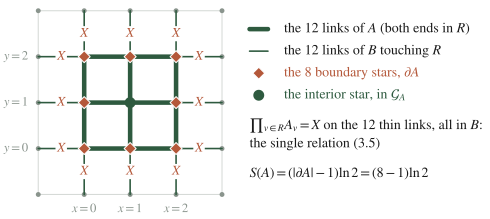
Figure 1. The disk for . The product of the nine stars of is on the twelve thin links, all in , the single relation (3.5); .
3.3 The Gauss-law reading [Proved.]
The ground state , with , is (3.1) with and exchanged: the plaquette group acting on the state with every , the electric loop gas of Sem I Week 7 §8. Lemma (3.4) with plaquettes, cut by the boundary at the outside plaquettes adjacent to the perimeter, gives (3.6) again, and the labels acquire a meaning. Let be the parity of the string links of at the boundary star ; since makes string degrees even, it is also the parity of strings leaving at . Each link of has both ends in and interior degrees are even, so for a configuration
the electric flux out of a charge-free disk is even, and the labels are the even boundary patterns.
Physical picture. Each cut star carries one bit, whether a string crosses the boundary there, and Gauss’s law integrated over the disk removes one bit. That constraint lives on the whole boundary, no single star sees it, and it is the entire of (3.6) [exact for the toric code; its survival in the phase is §4.4].
3.4 Every ground state, and a second derivation [Proved.]
A stabilizer state on qubits is fixed by a group of Pauli strings (here stars, plaquettes and two logical operators), and by Week 8 (2.2). Tracing out kills every with a nontrivial factor on , Pauli strings being traceless, and gives on the subgroup supported in :
with the projector onto the joint eigenspace of , of dimension . So every Rényi entropy equals the von Neumann one,
For the disk, , and is generated by the plaquettes inside and the stars of : the counting of §3.2 and its dual exclude other stabilizers, and no logical operator fits in a disk. Thus , (3.6) again, in every stabilizer ground state. For superpositions, the lemma of Week 8 §7.2 gives for Pauli strings in , so is the same on all of , and so is : a disk cannot tell the ground states apart. Check: ranks over give (3.6) in , and of Week 8 (5.3) for disks up to on the torus and on the torus.
4. The topological entanglement entropy
4.1 The constant and the boundary
KP, eqs. (1)–(3): for a disk with smooth boundary of length in a gapped two-dimensional medium, , with α nonuniversal, and over the superselection sectors. For the toric code (Week 8 §4.2), and KP note that had been found by HIZ. (3.6) has this form, and the combinations below isolate γ by cancelling the boundary terms identically (F3).
4.2 Kitaev–Preskill [Proved for the toric code.]
KP divide a disk into regions , , meeting at a point, with exterior (their Fig. 1), and form their eq. (5),
With for each region the interface lengths cancel and the constants give . On the lattice let be the regions containing links of the star ; then exactly when meets and its complement. Table 1 tallies the signs of (4.1) over the regions with .
| regions with | ||
|---|---|---|
| one region | none | 0 |
| , , , | ||
| , , , | ||
| , , , , , | ||
| all except | ||
| all seven |
Table 1. One star’s contribution to ; other cases follow by permuting , , .
If every region of (4.1) and its complement are connected, so that throughout (3.7), and no star touches all four regions, then , , and
All regions lie in one disk, so by §3.4 every ground state gives the same values. Check (Figure 2): on the torus, with the disk of links with both ends in the vertex square , its links with midpoint , the remaining ones with midpoint and the rest, (3.10) gives , each , and in , and . A star where four regions meet adds (Problem 2).
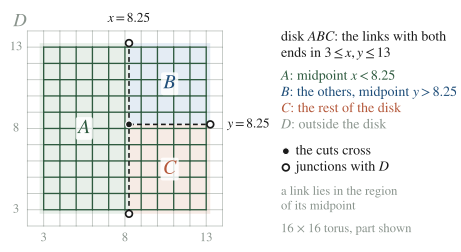
Figure 2. The regions of the check: the disk cut by and, to its right, by . The cuts cross at ● inside the plaquette , whose corner stars each touch two of , , ; ○ mark where a cut meets , at the stars , and . No star touches four regions, nor , and together.
4.3 Levin–Wen [Proved for the toric code.]
LW take an annulus , the annulus cut at the top, , cut at the bottom, , and cut at both, (Figure 3), and state in their eq. (1) that , with their over string types, 2 for the string net. and are the entropy changes on closing the top cut with the bottom closed and open; with only local correlations they agree. For the toric code, (3.7) gives
with for the annulus and for . The stars changed by closing the top cut are the same in as in , and likewise at the bottom, so and
LW compute on the honeycomb lattice with each boundary link split in two and find for split links and boundary curves; (3.7) is that formula with stars, since counts the boundary curves of a planar region. Check: on the torus, with the links whose midpoint has and the cuts its links with above and below the center, , with 60 boundary stars each.
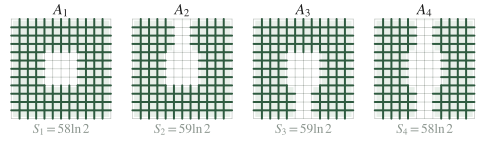
Figure 3. The Levin–Wen regions of the check: , the links with on the torus, cut at the top, at the bottom, and at both, with the entropies of the check.
Physical picture. A Wilson loop inside the annulus equals the product of the plaquettes it encloses, 1 on every ground state: no in the hole (Week 8 (4.3)). It lies in and is cut in ; its definite value is a second Gauss constraint, the flux through the inner boundary even separately from the outer one, which is the extra of . Away from the solvable point LW use a fattened string operator [Heuristic beyond the toric code].
4.4 Why the constant is universal [Stated — refs: KP; LW.]
KP argue that is a topological invariant of the arrangement, since deforming an interface or moving a junction changes the entropies by local amounts that cancel in (4.1), and that it is constant along gapped paths while ξ stays small compared with the regions; their comes from topological field theory on a doubled surface, for spheres with three and four punctures. LW derive their eq. (1) for all string-net models. (4.2) and (4.4) are exact; γ = ln 2 in the whole toric-code phase rests on these arguments.
5. The code: logical operators, distance, recovery
5.1 Logical operators are homology classes
Week 8 §3.4 identified the logical group with of the surface: Wilson loops modulo plaquettes and electric cuts modulo stars. A stabilizer code is an code, with logical qubits and distance
5.2 The distance [Proved.]
Let commute with every star, so that is a 1-cycle, and let count its horizontal links in column . Summing the degrees of over the vertices , each vertical link of that column contributes 2 and each or contributes 1, so
The common parity is the number of links of crossed by the dual line , the commutation sign with : winds in exactly when it is odd, and then every column contains a link of , . A cycle winding in has a vertical link in every row, . The dual argument bounds -type operators, and a nontrivial has weight at least . The straight loops of Week 8 (3.10) attain the bound:
Check: enumerating the cycle spaces of the , , , and tori gives minimal weights for the classes winding in , in and in both.
5.3 Recovery [Proved.]
The syndrome of a Pauli error is the set of violated generators, the anyons creates (Week 8 (4.1)). A decoder applies with the same syndrome; then , and recovery succeeds when . If has minimal weight and ,
by (5.1); combinations of such strings are corrected too, since syndrome measurement projects onto one syndrome. In anyon language the decoder pairs the anyons by strings, and it fails exactly when error and correction strings together form a noncontractible loop, a nontrivial logical operator by Week 8 §3.4.
5.4 A protected memory [Proved for Pauli strings; the splitting Sketched in Week 8 §7.2; Stated — refs: BHM.]
For supported on fewer than qubits,
each Pauli string in either anticommutes with a stabilizer and gives 0, or by (5.1) lies in . This extends the statement of §3.4 from disks to every set of fewer than qubits, and local perturbations split the ground states no earlier than at order , Week 8 (7.4). BHM prove the rigorous form for commuting-projector codes that include the toric code: below a constant perturbation strength the lowest band stays gapped and has width exponentially small in the system size [Stated — refs: BHM].
5.5 The planar code: rough and smooth edges [Proved.]
Take vertices with , ; horizontal links with , , those with and dangling; vertical links with , ; a star at every vertex and plaquettes for , . This is the planar code of DKLP §III.B, after Bravyi and Kitaev (Figure 4): the left and right edges are rough (dangling links, three-link plaquettes), the top and bottom smooth (complete plaquettes, three-link stars). Here , with stars and plaquettes, all independent: forces α constant on the connected vertex graph and zero at the dangling links, and forces β constant and zero on the plaquettes whose boundary links lie on a smooth edge. So
with the logical pair
a -string from rough edge to rough edge and an -string on the dual line from smooth edge to smooth edge, sharing . The argument of §5.2 holds with the stars of columns relating the columns of horizontal links, and dually with the plaquettes of each row relating its two rows of horizontal links, so
as DKLP state (check: ranks and enumeration for ). A -string ends on a rough edge without creating an , the missing endpoint having no star, and an -string ends on a smooth edge without creating an , as DKLP describe for defects: the edges are condensates in the sense of Week 8 §7.5, and , carry and between them (Problem 3).
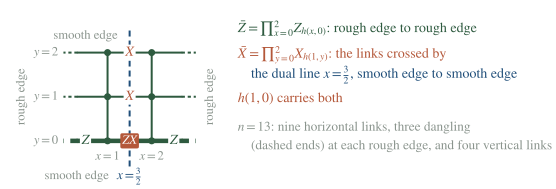
Figure 4. The planar code for : nine horizontal links, three dangling (dashed ends) at each rough edge, and four vertical links. is on the row ; is on the links , crossed by the dual line ; , marked , carries both.
6. Decoding as statistical mechanics
6.1 The error model
DKLP §IV.A take independent and errors at rate on each qubit. Every generator is a product of ‘s or of ‘s, so errors are seen only by plaquettes and decoded separately; we take errors and perfect syndromes. An error is a set of links with
its syndrome is the set of plaquettes with an odd number of links in , the ‘s at the ends of read as a dual chain. A decoder chooses with the same syndrome; recovery succeeds when is a product of stars δα and fails when it is homologous to , or (Figure 5). The optimal decoder picks the most probable class given .
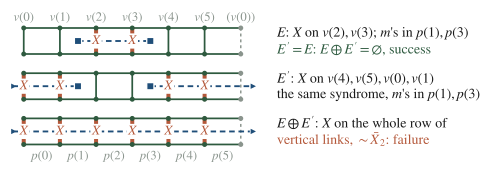
Figure 5. One row of plaquettes of the torus. Both corrections have the syndrome of ; the second closes the pair around the torus, and is the row of vertical links, a representative of .
6.2 The random-bond Ising model [the identity Proved; Stated — refs: DKLP §IV.]
Fix with syndrome . The chains with syndrome in its class are , with α and its complement giving the same chain. Put spins on the vertices and for , otherwise. A link lies in δα exactly when , so
With and ,
and summing over the class,
The quenched disorder is the error itself, each bond antiferromagnetic with probability , at the coupling : the Nishimori line of the random-bond Ising model, DKLP’s . Another class is , with the column representing or the row representing ; adding reverses the bonds on a seam across the torus, an antiperiodic boundary condition τ:
Δ being the free energy of the domain wall the seam forces. The choice of within its class does not matter, by the gauge symmetry , on the links at , the move that made the pinned interface of Sem I Week 5 §7.2 independent of its surface; the four classes are the four torus boundary conditions of the Ising model of Sem I Week 4 §3.4. Check: on the torus at , summing (6.1) over all error sets reproduces , computed over all spin configurations, to ten digits, in every class, for three choices of .
6.3 The threshold logic [Sketched; numbers Stated — refs: DKLP; HPP; WHP.]
(i) By (6.5) the optimal decoder fails with probability equal to a disorder average, over η drawn with the error statistics, of the weight of the wrong classes: an average on the Nishimori line. (ii) In the ferromagnetic phase the seam forces a domain wall of length at least , for typical η, and failure vanishes as ; DKLP state that the correct class is then separated from the others by a free energy linear in . (iii) In the paramagnetic phase , the four classes become equally likely and failure tends to . (iv) The threshold is the Nishimori point, where the Nishimori line crosses the phase boundary. The omitted step is the control of the disorder average, the statement that typical and averaged domain-wall free energies scale alike (DKLP §IV.E–G). From the domain-wall free energy computed with transfer matrices, HPP place the Nishimori point at , the value DKLP quote as their (41); DKLP compare it with , where the rate achievable by codes of this type vanishes, their (42)–(43). The minimum-weight decoder minimizes , the energy, and its threshold is the zero-temperature transition, (WHP).
6.4 A threshold exists: a Peierls bound [Proved.]
For the minimum-weight decoder on the torus, suppose recovery fails. Then is an even subgraph of the dual lattice with nontrivial class, a union of link-disjoint simple dual cycles of which one, , is noncontractible, so by (5.3). Since has the syndrome of , minimality gives , and each link of lies in exactly one of , , so and
A fixed set of ℓ links holds at least ℓ/2 errors with probability for , each term being at most . A simple dual cycle of length ℓ is traced by a non-backtracking walk from one of its dual vertices, with at most walks from each, so
which vanishes as for , that is, . The bound is crude (at its right side is for and for ); DKLP §V refine such counting with self-avoiding walks.
6.5 Faulty measurements: a random-plaquette gauge theory [Stated — refs: DKLP §IV; WHP.]
If each syndrome bit is also wrong with probability , the decoder works with the syndrome history in spacetime: qubit errors are links within time slices, measurement errors links along time, and histories with the same boundary lie in one class when they differ by the boundary of a set of plaquettes. The sum over a class is then a three-dimensional gauge theory with quenched random plaquette signs on a Nishimori line, whose confinement–Higgs transition is the threshold. Imperfect syndromes cannot help, so for every ; DKLP §V prove for , and WHP find the zero-temperature transition, a lower bound, at . The model is Wegner’s theory of Sem I Week 5 with random signs, and the memory works in its ordered, deconfined phase; Problem 6⋆ derives the mapping.
7. Mini-calculation 3 (hand-in)
7.1 Scope
Exact on finite tori, using §§3–5 and the stabilizer formalism of Week 8 §2. Nothing is claimed about the perturbed phase, where γ = ln 2 rests on §4.4, and no numerical input from the literature is used.
7.2 Variable dictionary
| symbol | meaning | where |
|---|---|---|
| , | complementary sets of links | §3.1 |
| , | stars acting on both and ; their number | §3.2 |
| ; , | the star group; its elements acting only on , only on | (3.2) |
| , | the graph of the links of ; its number of components | (3.7) |
| stabilizers of supported in | (3.9) | |
| the Kitaev–Preskill combination | (4.1) | |
| the distance | (5.1) |
7.3 Sub-tasks
Sub-task 1: the Schmidt decomposition, explicitly. On the torus, build as its configurations in the basis, take the twelve links with both ends in the vertex square (Figure 1), and compute by grouping configurations by their restriction to . Give coset representatives of as products of boundary stars and verify (3.3). Deliverable: the 128 labels and the spectrum of . Checkpoint: Schmidt rank , all eigenvalues , ; on the torus a single plaquette gives rank 8 and .
Sub-task 2: the constraint across the cut. For the disk derive (3.6) by the counting of §3.2, then evaluate (3.10) by hand and show that the counts agree. Deliverable: both derivations. Checkpoint: , , ; for , , .
Sub-task 3: γ two ways. On the torus evaluate (3.10) by ranks over for the regions of the checks in §§4.2 and 4.3, in and in . Deliverable: the eleven entropies, the boundary-star counts and both combinations. Checkpoint: for the seven regions of (4.1), boundary counts one larger, ; with 60 boundary stars each, and (4.4); identical in both states, so .
Sub-task 4: the distance. Prove (5.3), confirm it by enumerating the cycle spaces of the , and tori, and repeat for the planar code with . Deliverable: the proof and the minimal weight in each class. Checkpoint: cycle spaces of dimension 10, 13, 17; minimal weights ; . The planar code has 13 qubits, 6 independent stars and 6 independent plaquettes, , and minimal , of weight 3.
7.4 What is proved, modeled and imported
Proved on every finite torus: (3.4), (3.6), (3.7), (3.10), (4.2), (4.4) and (5.3), all counting statements. Computed: the numbers of Sub-tasks 1, 3 and 4. Imported: nothing.
8. Seminar: Kitaev–Preskill and Levin–Wen
Format. Two presenters, one per four-page paper, in the format of syllabus §7, then a joint discussion. Everyone reads both papers and brings Problem 2.
Sections. KP in full: eqs. (1)–(5), Fig. 1, the invariance argument, the doubled-surface computation in outline. LW in full: eq. (1), Figs. 1–3, the toric-code example, the string-net result.
The technical claim. A gapped two-dimensional medium has for a disk, (KP (1)–(3)); the combination (4.1) cancels α and is a topological invariant and universal (KP); for string-net states (LW (1)).
What it needs from Semester I. The electric loop gas of Sem I Week 7 §8 and the Gauss law; from Semester II, from Week 8 §4 and §§3–4 of this note.
The step at the board. LW’s toric-code computation: split the boundary links (their Fig. 3), decompose the loop gas over the even boundary patterns, their eq. (2), obtain and compare with (3.6) and (3.8); then for the four regions, against (4.3).
For the discussion. Why KP’s regions may meet only at junctions of three (Problem 2); what the annulus knows that a disk does not (§4.3); what a smooth deformation of the Hamiltonian requires on the lattice.
The open question it leaves for this course. Neither paper proves that implies long-range entanglement in the sense of (2.4); spurious constants (F4, Problem 8⋆⋆) make the question real.
On the course map. is the total quantum dimension of Week 8 §4.2, which normalizes in Week 8 (5.5); for Week 10’s quantum doubles ; LW’s strings are the string nets of Week 11.
9. Subtleties and fine print
F1. Cat states. By (2.3) an exactly SRE state has no connected correlations beyond , and an SRE state in the phase sense of (2.4) has connected correlations that decay exponentially. The GHZ state, a sum of two product states, keeps a connected correlation of order one at every distance, so it is LRE in both senses. CGW’s classification concerns gapped ground states, applied with a degenerate ground space to the states that cluster, here the two product states. (2.5) needs no such choice: it excludes every state of , all of which cluster for local operators by (5.5).
F2. Ancillas. CGW let circuits act together with ancillas in a product state, so that systems of different sizes can be compared; the proof of (2.5) is unchanged.
F3. The constant of one region. The split of (3.6) into per star and depends on the boundary measure: in terms of the links of touching the same entropy is , and LW’s split links give another count. Only combinations that cancel every boundary term, (4.1) or (4.4), with regions meeting as in Figures 2 and 3, determine γ.
F4. Spurious constants. Zou and Haah show that a class of short-range entangled states on a cylinder have Rényi entropies of index α ≥ 2 equal to with , which the usual extrapolation would call topological; the effect is tied to a one-dimensional SPT order that appears after disentangling the spins far from the cut. For stabilizer states, (3.9) makes all Rényi entropies equal, so a spurious constant in one would appear in all.
F5. Regions that wrap. (3.7) holds in for every bipartition, but the entropy of a region containing noncontractible loops depends on the ground state; for a strip around the torus the states of Week 8 (5.1) minimize it (Problem 5⋆).
F6. Away from the fixed point. In the perturbed code of Week 8 §7 the logical operators become dressed strings of width of order ξ, the splitting is of order (§5.4), α changes, and γ = ln 2 holds only for large regions (§4.4), while the exact counts of §§3–5 hold at the solvable point.
F7. Decoder and noise. The threshold depends on the decoder (0.1094 for the optimal one against 0.1031 for minimum weight, §6.3) and on the noise: decoding and errors separately assumes that they are independent, and correlated noise changes the statistical model.
10. Common misconceptions
“Topological order means a nonzero topological entanglement entropy.” It is tempting because γ is the most quoted diagnostic. Topological order is long-range entanglement, (2.4), proved for the toric code by (2.5); γ is a diagnostic of it, with the caveats of F4.
“Short-range entangled states are trivial.” It is tempting because without symmetry all SRE states form one phase. With a symmetry imposed they need not be: the cluster chain of §2.2 is SRE and a nontrivial SPT.
“Distance means protection only when errors are as rare as per qubit.” It is tempting because (5.4) is the only guarantee valid for every error. Distance guarantees the correction of errors placed by an adversary, while a rate below threshold produces about of them, and these are corrected with probability tending to one, (6.7) and §6.3, because they form small clusters.
11. Historical note
Kitaev introduced the toric code as a quantum code in 1997, and Bravyi and Kitaev (1998) put codes on lattices with boundary. DKLP (posted October 2001) wrote the fault-tolerance paper behind §§5–6: planar codes with rough and smooth edges, recovery as the random-bond Ising model on the Nishimori line and, with faulty measurements, as a disordered three-dimensional gauge theory, and threshold bounds from self-avoiding walks. HIZ (2004) found the entropy of the toric code to be the boundary length up to an additive constant, which they related to topological order. KP (posted 11 October 2005) and LW (23 October 2005) independently identified the constant as a universal invariant, in back-to-back letters of 2006, KP noting the earlier toric-code value of HIZ. BHV (2006) showed with Lieb–Robinson bounds that topological order cannot be created quickly from a product state, and CGW (2010) made local-unitary equivalence the definition of a gapped phase.
12. What to take away
- Technical: a circuit of depth and range moves supports by at most , (2.2); SRE means connected to a product state by an LU evolution, which such circuits approximate, (2.4), and exact preparation by one kills every connected correlation beyond , (2.3). Physical: a shallow circuit cannot make two anticommuting nonlocal observables sharp, so no exact shallow circuit makes the toric code, (2.5), and BHV extend this to LU evolutions.
- Technical: a group state has equal Schmidt coefficients, (3.4), and a disk has , (3.6). Physical: one bit per cut star, minus the bit fixed by Gauss’s law, (3.8).
- Technical: the KP and LW combinations cancel the boundary terms star by star and give and , (4.2) and (4.4). Physical: is read from the wavefunction alone.
- Technical: the toric code is and the planar code . Physical: logical operators are homology classes, rough and smooth edges absorb and , and nothing on fewer than qubits sees the encoded information, (5.5).
- Technical: decoding classes have random-bond Ising weights on the Nishimori line, (6.4)–(6.5), and a threshold exists, (6.7). Physical: the memory is the ordered phase, where a seam around the torus costs free energy proportional to .
13. Looking ahead: Sem II Week 10
Sem II Week 10 passes to , where §3 gives per boundary star (Problem 1), and to finite groups, whose quantum doubles have and so by KP’s formula; it also compares §5.4 with Wen and Niu. Week 11 reads the loop gas of §3.3 as the simplest string net, with LW’s .
14. Problem set
Routing: Problems 1–4 are the classroom core (Problem 2 is brought to the seminar), 5⋆–7⋆ are self-study consolidation, and 8⋆⋆–9⋆⋆ are research extensions.
Core problems
1. The toric code (extends §§3.1–3.2). With the clock and shift of conventions §§6, 9 and the stars of Week 8 F4, let , generated by the stars and every on . (a) Show that is a ground state and that (3.3)–(3.4) hold, with in place of in the orthogonality argument. (b) Show for the disk of §3.2 and compare γ with for abelian anyons. (c) For on the torus and a plaquette, give the number of configurations, the Schmidt rank and .
2. A star where four regions meet (extends §4.2). (a) If each region of (4.1) and its complement are connected in the sense of (3.7), show , with the number of stars whose links lie in four different regions. (b) On a large torus take the disk of links with both ends in ; let be its links with midpoint together with , , , the remaining links with midpoint , and the rest. Find and . (c) Which assumption of KP fails, and how must lattice regions be drawn?
3. Other patches (extends §5.5). (a) For the patch with rough left and right edges and smooth top and bottom (vertices , ; horizontal links , ; vertical links , ), find , the independent stars and plaquettes, , and the weights of the shortest and . (b) For the grid of vertices with all its links, so that every edge is smooth, find and explain it with the boundary condensates. (c) Which anyon does each kind of edge absorb, and which string ends on it?
4. Failure at small error rates (extends §§5.3, 6.4). errors at rate on the torus, odd, perfect syndromes, minimum-weight decoder. (a) Show that no error of weight at most causes failure. (b) Show that an error of weight causes failure exactly when it lies on one of the straight dual loops of length , and that the decoder meets no ties at this weight. (c) Conclude , evaluate the coefficient for and compare with (6.7).
Starred problems
5⋆. Cylinder cuts and minimal-entropy states (extends §3.4, F5 and Week 8 §5). For the links with both ends in the rows of the torus: (a) by (3.10), in , in and in ; (b) has ; (c) the minimal-entropy states for this cut are the eigenstates of anyon flux along , and the overlaps of the minimal bases of the two cuts give of Week 8 (5.5). Hint: and have representatives inside and inside ; those in make vanish for , those in separate the remaining blocks.
6⋆. Faulty measurements (extends §6.2 to §6.5). Let be the dual lattice of the torus times discrete time, with qubit errors on links within slices (rate ) and measurement errors on links along time (rate ). Show that chains in one class with a given boundary differ by boundaries of plaquette sets of , and that the probability of a class is proportional to the partition function of a gauge theory on the lattice dual to , with plaquette couplings , on time-like and on space-like plaquettes, η fixed by a reference chain. Identify the gauge invariance and the phase in which the memory works. Hint: repeat (6.2)–(6.4) with 2-chains in place of α, and dualize as in Sem I Week 5 §7.1.
7⋆. The planar code is long-range entangled (extends §2.3 to §5.5). Adapt (2.5) to the planar code, find the largest light-cone radius it excludes, and explain the difference from the torus. Hint: the rows and carry homologous ‘s whose product is the product of all plaquettes, and they need not wrap.
⋆⋆ problems
8⋆⋆. Spurious topological entropy. Known: KP and LW argue that their combinations equal and for regions large compared with ξ; Zou and Haah exhibit short-range entangled states with spurious constants in cylinder Rényi entropies. Explored: the conditions on regions under which the KP or LW combination certifies long-range entanglement in the sense of (2.4). Sources: KP; LW; CGW §§IV–V; Zou–Haah. Completion: a stabilizer state made by a circuit of bounded depth whose KP or LW combination is nonzero for some geometry, verified with (3.10), and a modified geometry or criterion that gives 0 for it and for the toric code.
9⋆⋆. Optimal decoding and the Nishimori point. Known: (6.4)–(6.5); (HPP) and (WHP). Explored: finite-size estimates of both thresholds from the failure rates of the two decoders. Sources: DKLP §IV; HPP; WHP. Completion: the optimal decoder through transfer-matrix values of for the four classes, the minimum-weight decoder by matching, failure rates with error bars on tori up to , and threshold estimates from the crossings, compared with the published values.
Self-study answer checkpoints
Problem 1. Decisive step: the elements of are the shifts , , distinct up to a common constant, so they move to distinct basis states, and the plaquette holonomies fix and commute with the stars; (3.3) uses only that the group acts freely on basis states. In §3.2 the cosets are labelled by α on modulo a common shift. Result: equal coefficients, , with ; for and a plaquette, configurations, Schmidt rank 27, (for , rank 64). Common failure: omitting the relation, which gives .
Problem 2. Decisive step: only the last row of Table 1 is nonzero, and when every . Result: (a) . (b) The star has , , , and is the only such star: , , with and every region and complement connected. (c) KP’s regions meet along interfaces and at junctions of three, smooth on the scale of ξ; on the lattice no star may touch four regions. Common failure: forgetting that this star is a boundary star of all seven regions.
Problem 3. Decisive step: the independence argument of §5.5, and in (b) the relation , restored because every link now has two endpoints. Result: (a) , stars and plaquettes, all independent, , shortest of weight and of weight ; for , with weights 3 and 4. (b) , star rank , plaquettes, ( for ): an -string between smooth edges is the product of the stars on one side, and a -string has no rough edge to end on. (c) Rough edges absorb , where -strings end; smooth edges absorb , where dual -strings end. Common failure: missing the relation in (b), which gives .
Problem 4. Decisive step: by (6.6) failure needs a noncontractible with . For odd no noncontractible cycle has length : winding in one direction gives an odd number of links in each of columns plus an even number of transverse links, an odd total, and winding in both needs . So is straight and ; conversely has weight , while any chain in the class of with its syndrome has weight at least , since with it forms a noncontractible cycle. Result: (a) from (5.4); (b) the straight loops are link-disjoint, so exactly errors of weight fail; (c) for and for , confirmed by minimum-weight decoding of every error of weight and , with no failures at the lower weight and no ties at either; ties do occur at higher weight (for , already at weight 3). Common failure: counting only the rows of vertical links.
Notes prepared for the generalized-symmetries course, Semester II Block 3. Written to the note-quality-template standard on 2026-10-02. Last revised 2026-10-04.