Sem II Week 8 — The Toric Code, Solved to the Bone
The toric-code has appeared three times in this course: at the Γ → 0 point of the Kogut–Susskind Hamiltonian in Sem I Week 7, as BF theory in Sem II Week 2, and as the gauged trivial paramagnet in Sem II Week 7. This week we solve the lattice model with the Pauli algebra as the only input: the stabilizer group and its two relations, the ground states on a surface of genus , the string operators with every fusion and braiding rule, and the modular and matrices. Then we perturb it. Each field of the Fradkin–Shenker problem condenses one anyon and confines the other, so the phase diagram of Sem I Week 13 is a diagram of two anyon condensations. Sem II Week 9 builds on the logical operators of §3.4, and Sem II Week 10 matches the modular data of §5 to a -matrix.
How to use this chapter
- In class: in the first hour, the dimension theorem (2.3), then the spectrum (3.1)–(3.3) with Figure 1, the two relations (3.4)–(3.5), the count (3.6) and the logical operators (3.9)–(3.10) with Figure 2; Problem 1. In the second hour, the strings (4.1)–(4.2), fusion (4.3)–(4.5), braiding (4.6)–(4.7) and the T-junction (4.8)–(4.11) with Figure 3, then the bases (5.1)–(5.3) and (5.5); Problem 2. In the third hour, (5.6)–(5.8) and the modular relations (5.9), then §§7.1 and 7.3–7.5 with Figure 4; Problem 3. The seminar hour (§8) is Kitaev’s section on materialized symmetry, presented by the instructor; students bring Problem 4.
- For self-study: §§3.5, 4.5, 6, 7.2 and 7.6, the fine print of §9 and Problems 5⋆–7⋆. The one calculation to do alone is the matrix by overlaps, (5.4)–(5.5), from (5.3).
- Instructor checkpoint: two errors recur. The Wilson loop along anticommutes with the electric cut along , so the -string that runs along belongs to the second qubit, (3.10) and F1. And is , the mutual braiding of the constituents, which on the torus is the sign of one crossing in (5.8).
0. Reading
Primary: Kitaev, “Fault-tolerant quantum computation by anyons”, quant-ph/9707021, Ann. Phys. 303 (2003) 2: in the arXiv text, whose introduction is unnumbered, §1 (toric codes, with the stability estimate), §2 (abelian anyons) and §3 (materialized symmetry, the seminar of §8); Sem II Week 2 §8 numbers these sections 2–4.
Secondary: Levin, Wen, Phys. Rev. B 67 (2003) 245316 [cond-mat/0302460], eq. (4) of §III and §V; Kitaev, Ann. Phys. 321 (2006) 2 [cond-mat/0506438], App. E.4–E.5; Trebst, Werner, Troyer, Shtengel, Nayak, Phys. Rev. Lett. 98 (2007) 070602 [cond-mat/0609048]; Tupitsyn, Kitaev, Prokof’ev, Stamp, Phys. Rev. B 82 (2010) 085114 [arXiv:0804.3175]. From the course: Sem I Weeks 7 (§§7–8) and 13 (§§6–7, 9, F5); Sem II Weeks 2 (§§3–4, 6.4, 7), 3 (§2) and 7 (§6.4).
Optional research reading: Bais, Slingerland, Phys. Rev. B 79 (2009) 045316 [arXiv:0808.0627]; Wen, Int. J. Mod. Phys. B 4 (1990) 239; Wen, Niu, Phys. Rev. B 41 (1990) 9377; Somoza, Serna, Nahum, Phys. Rev. X 11 (2021) 041008 [arXiv:2012.15845]; Dennis, Kitaev, Landahl, Preskill, quant-ph/0110143 (Week 9).
Proof-status labels as in note-quality-template §4. Signs are from conventions §§4, 6 and 9; and are those of Kitaev’s App. E, (223) and (232)–(233), as in Sem II Week 10 (6.1). Every count, commutation phase and modular relation was checked by script with explicit stabilizer matrices or state vectors, named where used.
1. Motivation and setting
The deconfined phase of gauge theory in dimensions contains one point where every question has an exact answer: the electric term is off, the Gauss law is an energy, and the Hamiltonian is a sum of commuting operators. We use it to answer three questions with the Pauli algebra alone. Why does the number of ground states depend on the topology of space, and only on it? What are the fusion rules, braiding phases and spins of the excitations? What destroys the order under perturbation? The first answer is a third derivation of the degeneracy, after BF holonomies (Sem II Week 2 §§3–4) and the Dijkgraaf–Witten sum (Sem II Week 7 §6.1). The second fixes the modular data. The third is where the semesters meet: when the gap of a moving boson closes, the boson condenses, the anyon that braids with it is confined, and the topological-order is lost; these are the Higgs and confinement transitions of Sem I Week 13, seen from the anyons.
2. The stabilizer formalism [Proved.]
2.1 Pauli strings
On qubits let , . Moving past costs and past costs , so
where mod 2; the exponent is a nondegenerate alternating form on .
2.2 The dimension theorem
A stabilizer group is a group of commuting Hermitian Pauli strings, signs allowed, not containing ; its code space is . The operator
is Hermitian and satisfies for , since multiplication by permutes the group; so and Π projects onto . Every in is ± a nontrivial, traceless Pauli string, since a scalar other than 1 would be or square to it. Thus
with and the rank over of the binary check matrix of the generators ( is injective on ). Applied to the group generated by , for linearly independent generators and any signs , the same argument gives
2.3 Logical operators
The centralizer , the Pauli strings commuting with all of , maps to itself, and elements differing by an element of act identically on it. In binary language is an -dimensional subspace on which the form of (2.1) vanishes, is , of dimension , and . The quotient has dimension and a nondegenerate induced form, and therefore a symplectic basis: pairs with , all other pairs commuting. This is Kitaev’s description of the protected space by the operators commuting with the stabilizers modulo the ideal they generate.
3. The toric code on a closed surface
3.1 The Hamiltonian and its spectrum [Proved; the spectrum Computed.]
Let Σ be a closed connected surface cellulated by vertices, edges and faces, with a qubit on each edge. On the square torus, is the link from to , the link from to , and the plaquette with lower-left corner . With conventions §9,
A star and a plaquette share no link, or two when is a corner of , so by (2.1) all terms commute, and (Figure 1). With eigenvalues ,
where , count violated stars and plaquettes. Every link has two ends and borders two faces, so and , are even. These are the only relations (§3.2), so (2.4), applied to all generators but one star and one plaquette, gives every allowed pattern the degeneracy . On the -site torus the level is
times degenerate, with . On the torus, at , as brute-force diagonalization of the matrix confirms. A pair of anyons costs 4 at every separation: no string tension.
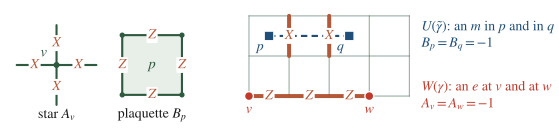
Figure 1. The star and plaquette of (3.1) and the open strings of (4.1): on a direct path puts an at each end; on the links crossed by a dual path puts an in each end plaquette.
3.2 The two global relations [Proved.]
A product , with and , equals , with the coboundary of conventions §1 mod 2 and ∂ the mod-2 boundary. It is the identity exactly when , which makes α constant on the connected Σ, and , which makes β equal on the two faces bordering each edge and so constant. These are , and they give exactly two relations,
so that
The only element of proportional to the identity is the product with α, β constant, which is , a product of and ; so .
3.3 ground states [Proved; checked by ranks over .]
By (2.3) and (3.5) the ground space has dimension , :
This is a second, lattice derivation of the BF count of Sem II Week 2 §4 at : there the degeneracy came from the holonomy algebra on , here from the Pauli algebra and the Euler characteristic, independently of the cellulation (Kitaev’s irregular lattices; Sem I Week 14 §7 counted for charge- matter in the same way). The ranks of the check matrices over , their Smith normal form over that field, confirm (3.5) on every torus with , and give on square-tiled surfaces of genus 2 (three squares glued as an L, , refined to ) and on a six-square surface of genus 3 refined to .
3.4 Logical operators [Proved.]
For a path γ of the direct lattice and a path of the dual lattice let
the second over the links that crosses (Sem II Week 2 (6.13) at ). commutes with every star exactly when is a 1-cycle, and the -type stabilizers are the , so the -type logical operators form ; likewise the -type ones are the closed modulo stars, . Since commutes with the stars exactly when does, and with the plaquettes exactly when does, the logical group is , and by (2.1)
with , the number of links of crossed by , the mod-2 intersection number. The closed are Wilson loops; the closed are the electric-flux operators of Sem I Week 7 §7.4, the generators of the electric of higher-form-symmetries (conventions §6). For a symplectic basis of , , , with isotopic dual curves , the logical qubits are
On the torus, with the row , the column , the dual line and the dual line (Figure 2),
of weights . The pairs and share the single links and and anticommute, every other pair shares no link, and all four commute with every stabilizer (checked on the torus): Kitaev’s loops and cuts .
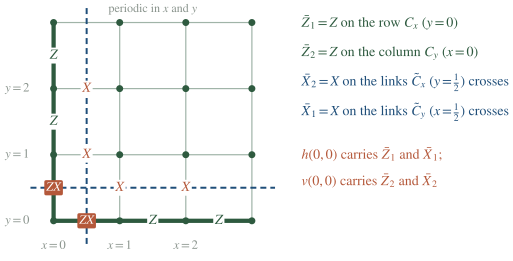
Figure 2. The logical operators (3.10), three columns of the periodic lattice. The links marked carry two of them: carries and , carries and .
3.5 The four ground states on the torus [Computed.]
, with every , has all and . With the group of the distinct products of stars, , and distinct flip distinct sets of links, so
In the basis, the basis of link variables , is the equal-weight superposition of the flat connections with holonomies , around , , Kitaev’s eq. (3); in the electric basis it is the loop gas of Sem I Week 7 §8. On the torus the four vectors of components are orthonormal and fixed by all eighteen stabilizers, and has 256 amplitudes, all .
4. Anyons from string operators
4.1 Strings and their endpoints [Proved.]
For an open direct path γ from to and an open dual path from plaquette to , (2.1) gives
while commutes with all plaquettes and with all stars: an interior vertex of γ touches two of its links, an endpoint one. So creates ‘s at and and creates ‘s in and (Figure 1), Kitaev’s and . An ε is an at with an in the plaquette to its north-east, created by . For two paths with ,
so they agree on every state with no in , and dually with stars.
4.2 Superselection sectors and fusion [Proved.]
For a disk of plaquettes with interior vertices , the exact identities
show that the boundary loops measure the - and -parities inside; operators on links strictly inside share no link with them and commute with both. The type of a region, , , , , is therefore invariant under local operations inside it, and for disjoint regions the eigenvalues multiply:
the fusion algebra
Each anyon is its own antiparticle. On the sphere a fixed anyon configuration spans one state, (2.4) at , so fusion has one channel, every and . Fusion is the product of strings: two ‘s meeting at a vertex annihilate because .
4.3 Braiding [Computed.]
Create an -pair by with one member inside a disk and the other far away, and carry around ∂R with , a product of stabilizers by (4.3) that fixes the ground state Ω:
with the commutation sign of the strings. An -loop and an open -string share an odd number of links, since starts inside and ends outside; two -strings or two -strings share no – pair; the ε-loop collects one sign from each factor. With ,
the braiding phase of conventions §9 and Kitaev’s anticommutation of with : the Aharonov–Bohm phase of a charge around a π flux. Checked on the torus for all nine pairs of nontrivial strings.
4.4 Exchange statistics from the T-junction [Computed; the meaning of (4.8) Stated — refs: Levin–Wen 2003.]
Let move a particle from site to a neighbour . For three neighbours of in clockwise order, Levin and Wen define the statistics by
Read from the right, both sides take particles at and to and through the same hops, but on the left the particle from ends at and on the right the one from does: the histories differ by one exchange, and Levin and Wen show that the ratio does not depend on the choice of hops (for fermions, , it is ). For Pauli-string hops each pair commutes up to a sign λ, and reversing three factors exchanges each pair once:
An hops by one and an by one , so . For ε at , , the hops east and north are
each anticommuting with exactly the two stars and two plaquettes at its ends. At with , , , so that is clockwise (Figure 3), , and overlap with against only on , so
The script finds the same for the four three-legged junctions at a vertex and for the other pairing ( to the south-west). This is Levin and Wen’s §V computation for Kitaev’s model.
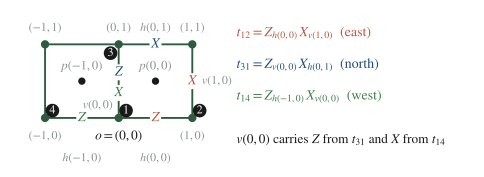
Figure 3. The T-junction for ε at : the hops (4.10) toward sites 2 (east), 3 (north) and 4 (west). Only carries a from one hop and an from another, so one pair anticommutes and .
4.5 Spins, monodromies and the Dijkgraaf–Witten labels [Computed.]
With and (4.7),
holds for all sixteen pairs, the monodromy relation of Sem II Week 7 §6.4. In particular : the spin of ε is the Aharonov–Bohm phase of its charge in its own flux. These are the data of Table 2 of Sem II Week 7 at , with the gauge field identified as and : is the pure charge, the pure flux, and . The individual -symbols depend on a basis of the fusion spaces, and the lattice computes their basis-independent combinations and . The double semion, with the same degeneracy, differs exactly here, with spins .
5. The modular data from the string algebra
5.1 Two bases of the torus [Computed.]
Let be the ground state with both loops along trivial, and (unique: they belong to different qubits), and define
where with a dual curve pushed off . Since and cross once, strings along them commute up to the signs (4.7), so
the -loops detect an -line along . The second basis exchanges the cycles: has and , with , . In the basis of (3.11), with and ,
5.2 The matrix [Computed.]
The change of basis
is a product of two single-qubit overlaps, each , negative only for and ; for instance . Thus
Kitaev’s App. E describes in these terms, as the transition between bases attached to Aharonov–Bohm measurements along two circles, and his (223), , is for abelian anyons; the data here are real, so conjugation conventions do not enter. The lattice realizes as a symmetry: the rotation about a vertex of the torus maps stars to stars and plaquettes to plaquettes, commutes with and the uniform fields of §7, and exchanges the classes of and . On the torus, with the qubits permuted explicitly, its matrix in the basis is exactly (5.5).
5.3 The matrix [Computed.]
The Dehn twist fixes and sends to . No lattice symmetry implements it; its action on the ground space is fixed up to one phase by its action on the loops, which carries the strings along to strings along :
The images obey the original commutation relations, so (5.6) is a unitary up to a phase, the logical CNOT controlled by the first qubit. It fixes up to a phase, which we set to 1. Then , and with ,
So . The sign is the single crossing of the -part of the twisted string with its -part; as an identity on the ground space,
while - and -loops multiply with a plus sign. On the torus we checked (5.8) with the staircase loop through and its pushed-off dual staircase, and the matrix of (5.6) computed from the explicit ground states is . The local value (4.11) and the global one agree, as they must for a property of the anyon.
5.4 The modular relations [Computed; the general statements Stated — refs: Kitaev 2006, App. E.]
With ,
Kitaev’s (232)–(233); by his (172), , so mod 8, as for any Hamiltonian real in the basis, whose complex conjugation reverses the chirality. The Verlinde formula, his (228),
returns (4.5), the rows of being the characters of . All of (5.9)–(5.10) were checked numerically. Sem II Week 10 §5.2 recovers θ and (4.7) from with the course signs of conventions §10: with and , and give and , and is (3.6) at .
6. The gauge-theory dictionary, completed [Proved.]
Sem I Week 7 §8 identified with the Γ → 0 point of the Kogut–Susskind Hamiltonian with the Gauss law as an energy, and Sem I Week 13 §9 the toric code in fields with the gauge–Higgs model in unitary gauge. Table 1 completes the dictionary.
| lattice operator | toric code | gauge theory (conventions §4) |
|---|---|---|
| creates or moves across ℓ | electric field | |
| creates or moves along ℓ | link variable | |
| an at | Gauss operator : a charge | |
| an in | a unit of flux: the vison of Sem I Week 7 §7.3 | |
| open , | - and -strings | open Wilson line; vison string |
| closed | Wilson loop: charged under the electric , generator of the magnetic one | |
| closed | electric-flux operator : generator of the electric |
Table 1. Each operator of §§3–4 with its gauge-theory name.
The charged sectors are anyons. The static-charge sectors of the Kogut–Susskind theory are the -excitations of , at energy for charges at , each -fold degenerate. On the -site torus the physical space of Sem I Week 7 §7.4, of dimension , is the sum over the allowed vison configurations of four-dimensional spaces, and its four electric-flux sectors are the eigenspaces of . The matter that gauging adds (Sem II Week 7 §6.5) is removed by the unitary gauge of Sem I Week 13 §9, , and restored by Kitaev’s construction in §8.
The two 1-form symmetries. At Γ = J = 0 the and commute with , and the ground space is the broken phase of both , with clustering states (Sem II Week 2 §§7, 9.5–9.6; Sem II Week 3 §2). The fields of §7 break them explicitly: , the hopping of dynamical charges, anticommutes with the that cross ℓ, and , the hopping of dynamical visons, with the Wilson loops through ℓ (conventions §6). In the deconfined phase both return as emergent symmetries, which is Kitaev’s materialized symmetry (§8).
7. The perturbed toric code: two condensations
7.1 The fields move the anyons [Controlled to first order in and ; the critical values Stated — refs.]
With conventions §4 the toric code in two fields is
the gauge–Higgs Hamiltonian of Sem I Week 13 §9 in unitary gauge, with e–m duality . By (4.1), creates, moves or annihilates ‘s at the ends of ℓ, and does the same for in the plaquettes sharing ℓ: is the kinetic energy of , Γ that of . For one far from its partner, between the states with the at the two ends of a link, and first-order degenerate perturbation theory gives
The band reaches zero at to this order; the transition at Γ = 0 lies at
lower because the same create pairs from the vacuum and dress particle and ground state; the number is the critical point of the transverse-field Ising model of §7.3 [Stated — refs: Blöte–Deng, Phys. Rev. E 66 (2002) 066110]. By duality at .
7.2 Stability of the degeneracy [the lemma Proved; the size of the splitting Sketched; checked numerically.]
Kitaev’s estimate rests on a lemma: a Pauli string whose support contains no noncontractible cycle of either lattice has . If anticommutes with a stabilizer , . Otherwise with a cycle and crossed by a closed dual curve (§3.4), all their loops contractible, so both are boundaries and is ± a stabilizer. For a perturbation by single-qubit Pauli terms, such as the fields of (7.1), the order- effective Hamiltonian is a sum of terms , with a combination of projectors onto stabilizer eigenspaces; since for a Pauli string , each term is a number times , a multiple of Π for by the lemma. The first splitting comes at order , from straight noncontractible strings; on the torus
Kitaev reads the coefficients as amplitudes for a virtual anyon to tunnel around the torus, , and finds that two-spin terms split the degeneracy no earlier than order ; we do not control higher orders, so throughout the phase is Sketched. At the are conserved; diagonalizing in each sector in the electric basis ( states) for Γ from 0.02 to 0.08, the splittings scale as on the torus and on the torus, with the sectors higher.
7.3 condensation is the Higgs transition [Proved through the exact map; the universality Stated — refs.]
At Γ = 0 the plaquettes are conserved and the ground state is flux-free. There the bond-algebra map for and takes (7.1) to the transverse-field Ising model of the matter, , in its sector and with the boundary conditions of (c) below (Sem I Week 13 §9; F6). A product of bonds along a path is an open Wilson string, so the Ising order parameter is
the amplitude to create a distant -pair; it decays exponentially in the toric-code phase and vanishes at . Long-range order of the operator that creates is what condenses means, and the transition is the three-dimensional Ising transition at (7.3). Three consequences follow. (a) The -parity of a region is no longer conserved and is absorbed by the condensate, : Kitaev’s Bose condensate of charged particles. (b) is confined: at the ground state is , and an -pair at separation flips bonds, at energy , string tension ; throughout the ordered phase the -string is a line of reversed bonds , a domain wall of the Ising order, since by (4.7) the condensate amplitude changes sign across it [Heuristic away from ]. (c) The degeneracy is lifted: in the conserved sector the product of the bonds around is , so the spins are antiperiodic along , which costs the ordered phase a domain wall of length and the paramagnet only by (7.4); the sectors are the four boundary conditions of the Ising model [the identification Proved; the energies Heuristic].
7.4 condensation is the confinement transition [Proved through the exact map; Stated — refs: Trebst et al. 2007.]
At the stars are conserved and the ground state is charge-free, where is the pure gauge theory of Sem I Week 7 §7.1 and the bond-algebra map , of Week 7 §7.3 gives the dual transverse-field Ising model in its sector . For the vison string has long-range order,
condenses. Dually, is confined with tension at , the strong-coupling tension of Sem I Week 7 §7.1 (Problem 3 adds the first correction), and the flux sectors split in proportion to . Trebst et al. treat this problem as a loop gas whose closed electric loops (§3.5) acquire a tension from the field: the order survives small tension, and at large tension a continuous transition condenses the magnetic vortices and confines the charges [Stated — refs: Trebst et al. 2007].
7.5 The condensation rules [Stated — refs: Bais–Slingerland 2009; the toric-code cases Proved in §§7.3–7.4.]
In a theory of anyons a boson , , can condense; then is identified with the vacuum and with , anyons with are confined, and the surviving classes form the anyons of the new phase [Stated — refs: Bais–Slingerland 2009]. In the toric code ε is a fermion, (4.11), and the fusion-closed sets of bosons with a nontrivial anyon are and . Condensing confines and ε, which braid with by , and identifies with 1; condensing confines and ε. Both leave only the vacuum, with a unique ground state on the torus, as §7.3(c) found: the only two condensations end in the trivial phase.
7.6 Both fields: the Fradkin–Shenker diagram as a condensation diagram [Stated — refs: Tupitsyn et al. 2010; Sem I Week 13; the anyon reading Heuristic where marked.]
With both fields no string operator is conserved, and the diagram at (Figure 4) is the one of Sem I Week 13 §7, translated into (7.1) in its §9. The toric-code phase is bounded by the -condensation (confinement) line from and the -condensation (Higgs) line from , which the duality exchanges. Tupitsyn et al. found by Monte Carlo on the three-dimensional gauge–Higgs model, up to , that the two lines stay second order until they merge into a first-order line, and predict the same structure for the toric code in two fields, which they map onto an anisotropic gauge–Higgs model [Stated — refs: Tupitsyn et al. 2010]. M lies on the self-dual line Γ = J, the first-order segment follows it to an endpoint E, and beyond E the two regimes are one phase (Sem I Week 13 §§6–7).
This week adds the reading. The confinement line closes the gap with gapped, the Higgs line the gap with gapped, and both condensates end in the trivial theory of §7.5: complementarity in anyon language, since past either line no superselection sector survives to tell the regimes apart [exact on the edges Γ = 0 and ; Heuristic inside]. What distinguishes them is the transition that leads to each and the interface each forms with the toric code, which absorbs ‘s in one case and ‘s in the other: two boundaries of the toric code, met again in the planar code of Week 9 [Heuristic]. At M the two bosons becoming gapless are mutual semions, (4.7), so no description by two commuting local order parameters applies, the difficulty Tupitsyn et al. single out; the transition at M appears continuous [Stated — refs: Somoza, Serna, Nahum 2021; Sem I Week 13 §7.1].
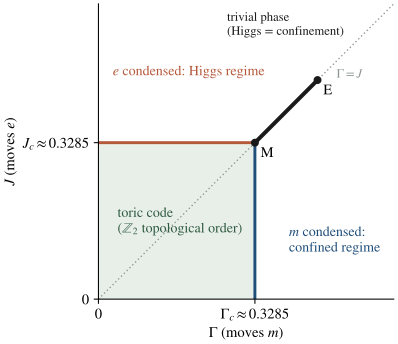
Figure 4. The toric code in two fields at : the toric-code phase is bounded by the - and -condensation lines from , mirror images under the duality, which meet at M on the self-dual line; the first-order segment M–E follows it. Shapes and the positions of M and E are schematic.
Physical picture. A simulation that measures the two open strings sees the regimes of Figure 4: in the toric-code phase both and decay exponentially, past the Higgs line the first saturates, past the confinement line the second, whose saturated value Problem 6⋆ computes. This is exact at the edges, where the Ising maps of §§7.3–7.4 hold; electric loops that proliferate at small tension and shrink at large tension are the heuristic loop-gas reading. For the research line, the confinement line is the simplest confinement by condensation of a magnetic defect, the form of the julia-toulouse-mechanism, to which Sem II Weeks 14–15 return (forward reference).
8. Seminar: Kitaev (1997), materialized symmetry, presented by the instructor
Format. The first seminar of Block 3, presented by the instructor as the model, in the format of syllabus §7. Students read §§1–3 of the arXiv text and bring Problem 4.
Sections. §3 of the arXiv text, “Materialized symmetry: is that a miracle?”, in full, with the stability estimate closing §1 and the tunnelling paragraph of §2. Sem II Week 2 §8 presented the first two sections and the opening of this one.
The technical claim. The perturbed toric code has no exact gauge symmetry, yet electric and magnetic charges are conserved mod 2 at long distances. Adding spins on vertices and faces and changing variables by a unitary writes any Hamiltonian in gauge-invariant form, Kitaev’s (6)–(8), and this artificial symmetry becomes a conservation law when it is not broken; when the Higgs field condenses, charges condense and vortices are confined, and dually.
What it needs from Semester I. Unitary gauge with matter and Elitzur’s theorem (Sem I Week 13 §§2, 9, F3), the dual Ising variables (Week 7 §7.3); from this note, §7.
The step at the board. Kitaev’s (6)–(7), in ten minutes. With spins on vertices, on faces and edge labels , the map , is an involution , since mod 2. Conjugated by , also flips on the edges at , so , and acquires in the exponent, so . On the stars and plaquettes equal and , and , his (8). is the Gauss law with matter of Sem I Week 13 §9 with : the construction is the unitary gauge run backwards. Then, in fifteen minutes, the mini-step of the week: the count (3.4)–(3.6) and , from the loop operators, (5.3)–(5.7).
For the discussion. Kitaev’s criterion for the broken gauge symmetry, a nonzero , depends on the gauge by Elitzur’s theorem and Week 13 F3; its invariant form is the long-range order (7.5). He closes by asking whether vortices can be confined with the gauge symmetry unbroken and answers that apparently they cannot; within boson condensation §7.5 gives the reason, since only an anyon that braids with confines it, and of and ε only is a boson.
The open question it leaves for this course. Transitions out of the toric code that no single boson condensation describes: the point M (Problem 8⋆⋆), and perturbations that move ε, the anyon that cannot condense.
On the course map. The materialized symmetry is the pair of emergent 1-form symmetries of §6, and the charges conserved mod 2 are the sectors (4.3).
9. Subtleties and fine print
F1. The choice of pairing. A loop pairs with the cut that crosses it once, so the -string along pairs with . On a change of symplectic basis in (3.9) acts on the logical qubits by a Clifford unitary, of which (5.6) and the rotation of §5.2 are the cases.
F2. Logical operators live on the ground space. Homologous loops agree only on states with no anyons between them, (4.2), and their ratio is otherwise the braiding (4.6). The operators (3.10) are representatives modulo stabilizers; the minimal weight in a class is the code distance of Week 9.
F3. Framing and the phase of . needs a pushed-off dual curve, and (5.8) records how the push-offs of and cross: the ε-loops represent up to , a quadratic refinement of the intersection form with value θ_ε. The string algebra fixes ; Kitaev’s App. E identifies the Dehn twist with , and here .
F4. The sign of the charge. In , and the Kogut–Susskind sign of conventions §4 is invisible. In a toric code with the clock and shift of conventions §4, and give , so by the Gauss law of §4. From , a link leaving has and a link entering has : the string from to creates Kogut–Susskind charges , , physical charges and [Proved].
F5. Exact and asymptotic degeneracy. The four states are exactly degenerate only at Γ = J = 0; in the phase the splitting starts at order (§7.2). Topological order belongs to the phase, through its gapped anyons and asymptotic degeneracy (Sem II Week 3); Week 9 adds entanglement.
F6. Ising transitions in a sector. The local operators of the toric code are the -even operators of the two Ising models of §§7.3–7.4, since carries a string, so the transitions have the Ising exponents of the even observables while the Ising order parameter has no local counterpart. On the torus the flux-free spectrum at Γ = 0 is the even sector under all four boundary conditions of §7.3(c), against the even and odd sectors of one for the periodic Ising model [Proved for the operator map].
F7. Other surfaces. (3.6) holds as on every closed surface, orientable or not (Problem 1); with boundaries the boundary conditions enter, as in the planar code of Week 9.
10. Common misconceptions
- “Spins multiply, , so ε is a boson.” It is tempting because the spin of a composite of distant particles is the product of spins. The constituents of ε also braid, and (4.12) gives , as the T-junction (4.11) confirms.
- “The Higgs and confined phases are different phases, distinguished by which anyon has condensed.” It is tempting because the two edges of Figure 4 are exact - and -condensates. The regimes are one phase (Sem I Week 13 §6), both condensates are the trivial theory (§7.5), and what differs is the transition and the interface with the toric code [Heuristic, as in §7.6].
- “The degeneracy needs the Gauss law imposed exactly.” It is tempting because Sem I Week 7 §7.4 found the four flux sectors with the Gauss law as a constraint. imposes it only as an energy, and the degeneracy survives every small local perturbation, split first at order (§7.2), which is Kitaev’s point.
11. Historical note
Kitaev posted his paper in July 1997; it appeared in 2003 (Ann. Phys. 303, 2). Its language is that of quantum codes: the code TOR(k) on a torus, stabilizers on vertices and faces, a protected subspace described by the operators commuting with them modulo an ideal, and a Hamiltonian that penalizes violated stabilizers. The anyons appear as endpoints of string operators, the degeneracy is rederived from their braiding by an argument Kitaev attributes to Einarsson, and the gauge-theory reading comes only in the third section, which wonders whether the emergent symmetry is a miracle; the non-abelian models of the rest of the paper belong to Week 10. The gauge theory was older: Wegner (1971), the Hamiltonian forms of Kogut–Susskind (1975) and Fradkin–Susskind (1978), the diagram of Fradkin and Shenker (1979), and Wen’s naming of topological order (1990). Levin and Wen (2003) gave the hopping definition of statistics of §4.4, and Trebst et al. (2007) and Tupitsyn et al. (2010) studied the perturbed code numerically.
12. What to take away
- Technical: , and stars and plaquettes satisfy exactly two relations, so . Physical: the degeneracy counts independent noncontractible loops; the lattice drops out.
- Technical: the logical operators are Wilson loops and electric cuts paired by the intersection form, (3.9)–(3.10). Physical: they are the order parameters and generators of the two broken 1-form symmetries.
- Technical: fusion , and follow from commuting Pauli strings. Physical: ε is a fermion because its charge sees its own flux.
- Technical: relates the anyon bases of the two cycles and is the lattice rotation; is the Dehn twist; . Physical: the modular data are Aharonov–Bohm measurements on the torus, and Θ = 1 says the code is non-chiral.
- Technical: moves and Γ moves ; each field condenses its boson through a three-dimensional Ising transition and confines the other anyon. Physical: the Fradkin–Shenker diagram is the diagram of two condensations of mutual semions, which end in one trivial phase.
13. Looking ahead: Sem II Weeks 9–11
Sem II Week 9 (Block 3) turns (3.10) into a code: the minimal weight is the distance, the lemma of §7.2 says no shorter operator acts on the ground space, and the loop-gas form (3.11) gives the disk Schmidt decomposition behind . Week 11 reads the electric loop gas of §3.5 as the simplest string net.
14. Problem set
Problems 1–4 are the classroom core (Problem 4 is brought to the seminar); 5⋆–7⋆ consolidate the self-study sections; 8⋆⋆–9⋆⋆ are research extensions.
Core problems
1. Nonorientable surfaces (extends §§3.2–3.4). (a) Show that the relations (3.4), and no others, hold on every closed connected surface with any cellulation, orientable or not, and conclude . (b) Evaluate it for the projective plane and the Klein bottle, and compare with . (c) Realize as the square, even, with and . Exhibit a -type logical operator along the midline and an -type logical operator anticommuting with it, and explain why one curve suffices.
2. The second Dehn twist (extends §§5.2–5.4). (a) Write the action of the twist , which sends to , on the operators (3.10). (b) With , compute its matrix in the basis . (c) Show and explain it with the rotation of §5.2. (d) Verify the braid relation .
3. The string tension of the confined anyon (extends §7.4 and Sem I Week 7 §7.1). At and , place static ‘s at vertices , of one row, a distance apart, on a large torus. (a) At , find the energy of the lowest state with relative to the ground state, and its degeneracy. (b) Compute the correction of order and read off the string tension. (c) Use the duality to state the result for two ‘s at Γ = 0, .
4. The anisotropic torus (extends §7.2). On the torus, , set and . (a) Show that the eigenvalues of , are conserved for every Γ. (b) Find the lowest order in Γ at which sectors differing in have different ground energies, and the same for . (c) Write the effective Hamiltonian at those orders and say which sector is lowest for Γ > 0.
Starred problems
5⋆. The e–m duality on the torus (extends §5.4 and Sem I Week 13 Problem 5⋆). (a) Send each link to the dual link crossing it, translate the dual lattice by onto the direct one, so and , and conjugate every qubit by the Hadamard gate; show that , and on the torus. (b) Find the action on (3.10) and on . (c) Show that the permutations of preserving and are the identity and . Hint: in (b) replace the image strings by homologous representatives; in (c), fixes ε.
6⋆. The condensate at strong field (extends §7.4). At , , : (a) find the ground state to first order in from , all ; (b) show for every open dual path from to , whatever its length; (c) show to all orders, and say which anyon has condensed. Hint: costs , and is diagonal in the electric basis and equals on only for .
7⋆. The toric code at finite temperature (extends §3.1 and Sem II Week 3 §4). (a) From (3.2), show that the Gibbs state on the -site torus has , , for a contractible loop around plaquettes. (b) Conclude an area law at every as , and name the excitations responsible. (c) Compare with the bound of conventions §6 for discrete -form symmetries, . Hint: the are independent except for , imposed by .
⋆⋆ problems
8⋆⋆. The multicritical point. Known: Figure 4; the Monte Carlo diagram of the 3d gauge–Higgs model and the map of the toric code in two fields onto an anisotropic one (Tupitsyn et al.); the continuity of the self-dual transition (Somoza, Serna, Nahum). Explored: how the condensation lines meet at M, where two mutual semions become gapless together. Completion: the transfer-matrix derivation of the anisotropic couplings that correspond to (7.1), the matter version of Sem I Week 7 §7.1, and an exact diagonalization of on the and tori locating the closing of the and gaps, compared with the published M and E. Sources: Tupitsyn et al. 2010; Somoza, Serna, Nahum 2021; Sem I Week 13 §7; Blöte–Deng 2002 for the single-field endpoints.
9⋆⋆. The Fredenhagen–Marcu ratio as a condensation diagnostic. Known: the Fredenhagen–Marcu order parameter separates the free-charge phase from the Higgs–confinement phase (Sem I Week 13 F5); (7.5) and (7.6) are the order parameters on the edges of Figure 4. Explored: an equal-time ratio for (7.1), the open string of length over the square root of the Wilson loop, as one diagnostic that vanishes in the toric-code phase and stays finite past both lines. Completion: leading-order evaluations in each regime and on the first-order segment, with a check on the torus. Sources: Fredenhagen, Marcu, Commun. Math. Phys. 92 (1983) 81 and Phys. Rev. Lett. 56 (1986) 223; Sem I Week 13 F5; Tupitsyn et al. 2010.
Self-study answer checkpoints
Problem 1. Decisive step: with coefficients the sum of all faces is a 2-cycle on every closed surface, each edge bordering two faces or one face twice, so survives where but . Result: : 2 on , 4 on the Klein bottle. On , on the midline (weight ) anticommutes with along the dual curve at height to , down through , on at height to the right edge, and back in at height through the twisted gluing (weight ): the generator meets its own push-off once, . Checked for (; the and Klein bottles give ). Common failure: dropping the plaquette relation, which gives .
Problem 2. Decisive step: fixes , and sends , , the logical CNOT controlled by the second qubit, which fixes . Result: in the order ,
because the rotation, whose matrix is , conjugates the twist along into the twist along ; the braid relation holds exactly. Common failure: transforming only the -strings in (a), which breaks the commutation of with and defines no unitary.
Problem 3. Decisive step: at , is diagonal in the electric basis, and the lowest state with has on the straight path from to . Result: (a) , nondegenerate; (b) each of the plaquettes adjacent to the string costs to flip instead of , so the shift relative to the vacuum is , and ; (c) , . Checked by exact diagonalization on the torus for . Common failure: omitting the vacuum’s shift, per plaquette, which doubles the correction.
Problem 4. Decisive step: at both commute with , and by the lemma of §7.2 sector energies differ only through products of along noncontractible dual loops; the shortest representative of has weight , that of weight . Result: with and , both positive since an -th order term carries and negative resolvents, so is lowest. On the torus the splittings scale as and . Common failure: giving the weight because of its index; it is the cut along .
Notes prepared for the generalized-symmetries course, Semester II Block 3. Written to the note-quality-template standard on 2026-10-02. Last revised 2026-10-04.